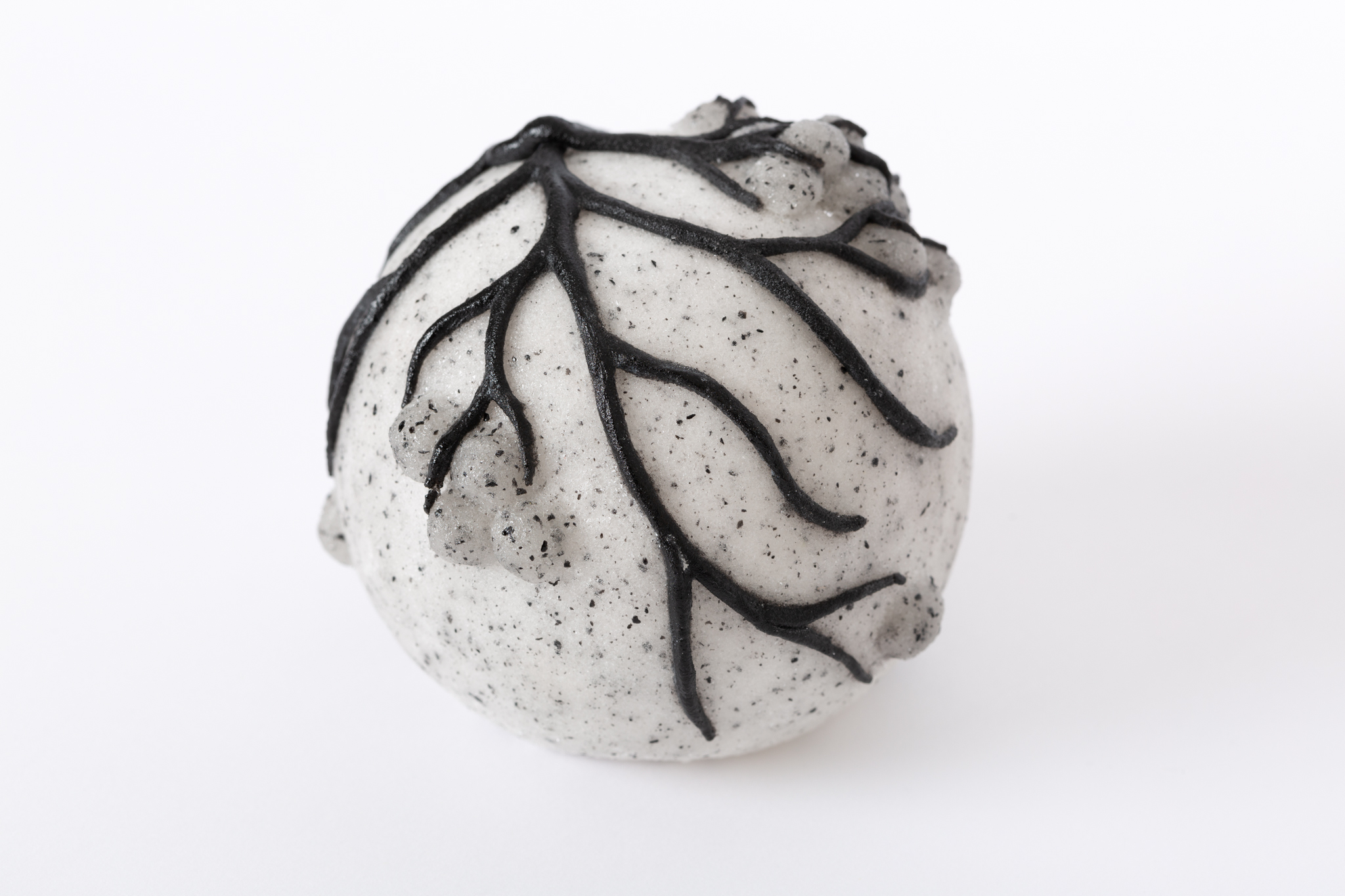
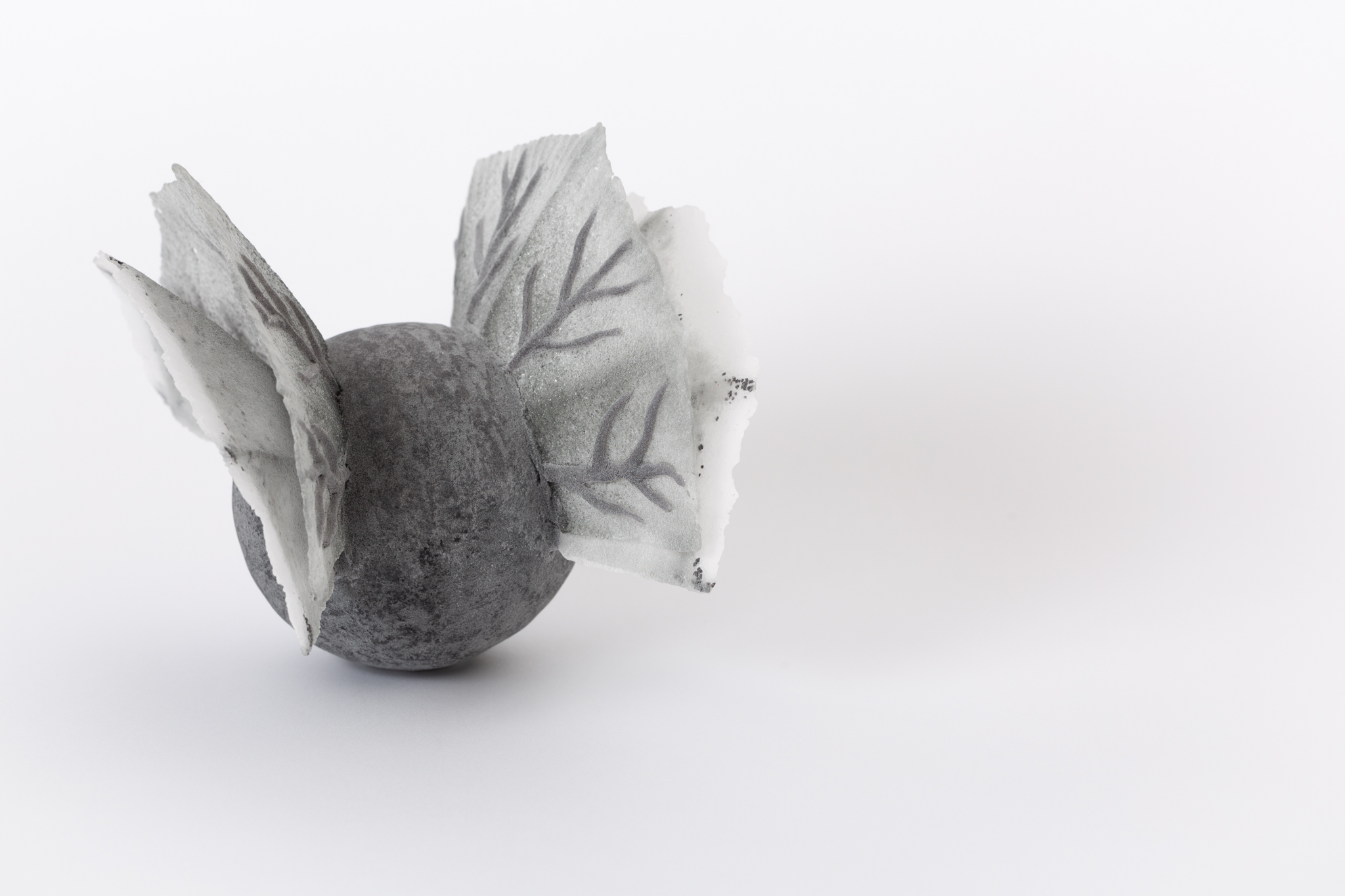
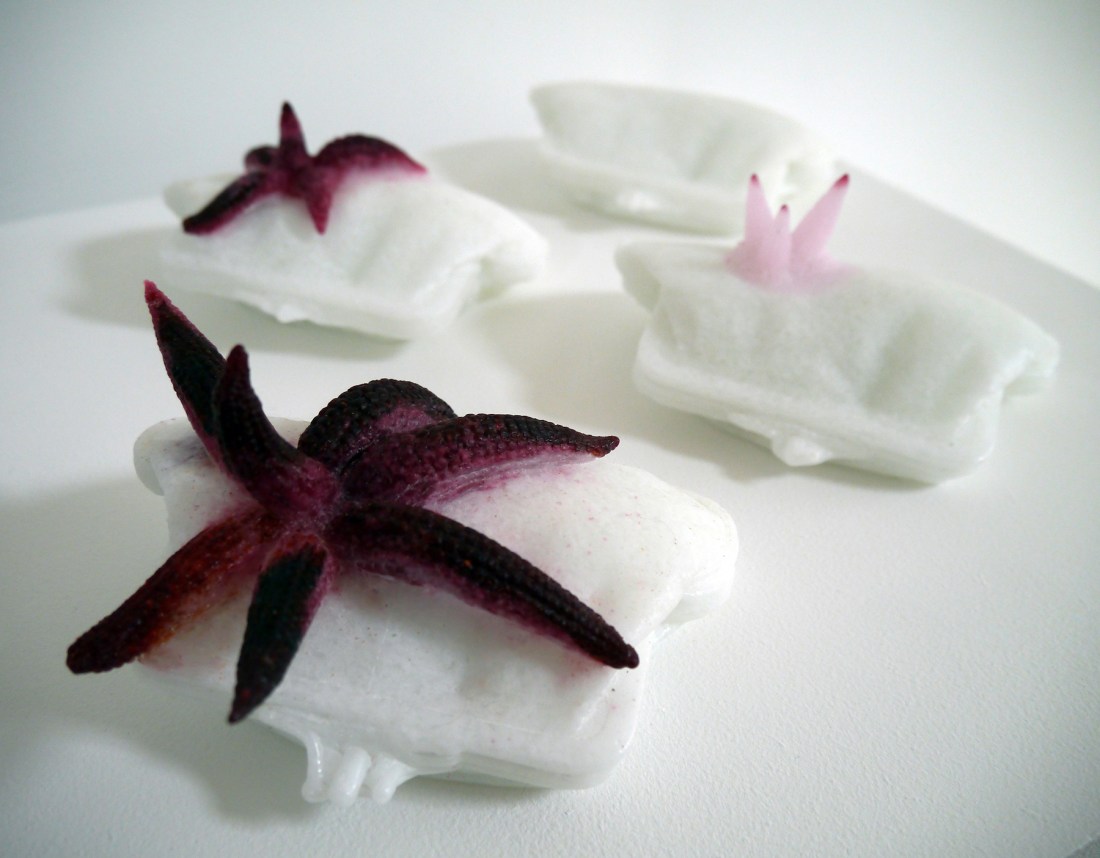
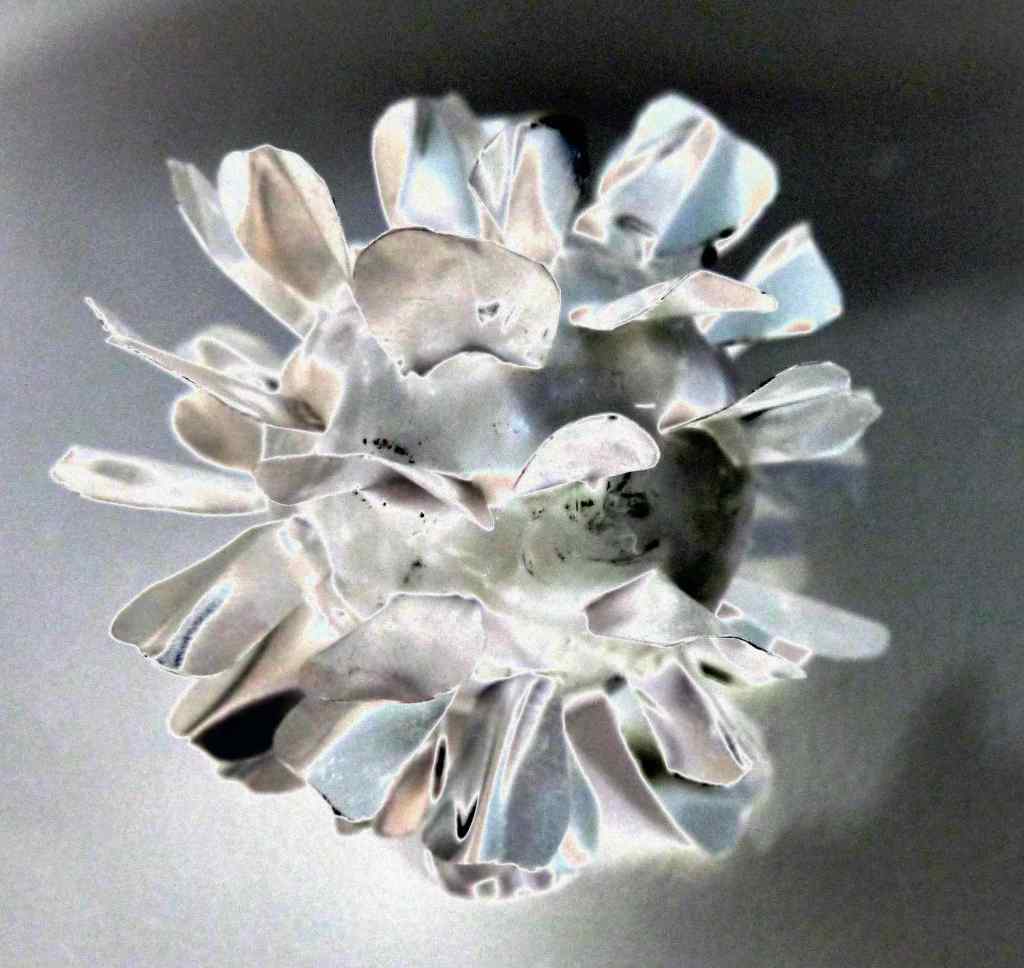
As the residency draws to a close, it’s a good time to share images of some of the prototypes and samples that I created alongside undertaking my other research. I always like to document my work and also to be in a position to provide high quality images where necessary, and I can’t do that with the snaps that I take myself. So instead I rely on my wonderful photographer and friend Robyn Manning. Before finishing the residency I took some of the samples and prototypes over to her studio to photograph, and here are the results.
Previously I wrote about my interest in how we visualise disease within our bodies and that one of my priorities as part of this project was to talk to people for my research who were, or had been, being treated at the Royal Marsden.
I was lucky enough to get the chance to talk to a small number of patients currently undergoing treatment or under observation. I am not recounting any medical detail that we discussed here; obviously I want to maintain the privacy of those who spoke with me. Rather I am reflecting on some of the more abstracted discussions about imagining disease that served as inspiration and provided visual ideas to investigate or develop further. And alongside these reflections are some brief observations about how the London Cancer Hub is experienced for some of those being treated there.
Visualising science
A couple of the patients I spoke to were particularly focused on understanding the science of their experience, although from different perspectives. One had been involved in research professionally, and continued their professional interest. Another was moved to research and understand as much as possible about the scientific mechanisms and processes governing their current experience. Both found the scientific information that they engaged with had an impact on how they imagined their disease. One had a detailed understanding of anatomy and felt that imagination and knowledge were generally in accord, whereas others had an imaginary world that might be influenced by their knowledge, but was not entirely at one with it.
Visualising cells
In at least one interview, we spoke at some length about visualising cells and about imagining how ‘cells go rogue’. As well as discussing the scientific mechanisms as far as we understood them, more of the conversation was dedicated to how cells might appear in our minds’ eye. One participant described their sense of a small, dark, translucent, hollow globe that represented the cancer cell in their mind’s eye, a cell that was somehow coated in invisibility to the immune system. This contrasted with their vision of healthy cells as a beautiful pink, full of delicate and intricate structures.
Visualising tumours
I asked several of my interviewees whether they had visualised their tumour, or indeed seen images or scans of their tumour and mainly they had not. We discussed how they imagined their tumour within their body. We also discussed the presence or absence of a tumour that you could feel from the outside of your body and the impact that had on your imagination, for example, thinking about the convex and the concave. One person described initially thinking of their tumour as smooth like an egg, but then reassessing after being told that what identified it initially as potentially malignant was that the lump had broken up when excised.
Because of this, eggs and broken eggs became really interesting metaphors for me that i would like to explore going forward. Eggs are both a site of growth – usually with a positive connotation although not always – and are also often used as an example of extreme fragility. These make powerful ideas to experiment with. I am planning on making a series of eggs and also playing with the japanese idea of kintsugi – the practice of highlighting imperfection through visible mending – alongside such pieces.
Visualising connections
I spoke to all my interviewees about the London Cancer Hub in terms of any expected or unexpected connections they had experienced through being part of a larger entity than the Royal Marsden itself. Several people mentioned the relationships within the RMH between Chelsea and Sutton. Others discussed referrals from other medical institutions and the relationships between their local hospital and the RMH.
With more than one patient I discussed their experience of using the Maggie’s Centre on the LCH site. They were extremely appreciative of the support they received from Maggie’s, and in particular the patient groups that Maggie’s facilitates which connected them with people who were going through or had gone through similar experiences.
With one patient in particular we went on to explore the idea of all the connections in a more abstract way. We spoke of bubbles, ripples, radial relationships and concentric circles. They spoke of Boolean searches and intersecting search terms and I replied with Venn diagrams. One of the striking features of the London Cancer Hub is not only the relationships within it but also so many relationships that connect it to other institutions, organisations, groups, both formal and informal. This conversation brought home to me the extent of the network that the LCH sits within.
Visualising ecosystems
We mostly didn’t get on to talking about the comparative ecosystems of cancer and the London Cancer Hub, but there was one exception which I want to record here because I particularly want to come back to it in thinking about sculptural compositions in relation to where this work takes me in the future. This was a conversation where my interviewee observed that one comparison between the two was that cancer was a system characterised by proliferation and spread, whereas the LCH would be characterised instead by unification and concentration. Somehow this had completely escaped me up to that point. It was, and remains, a very useful and potentially productive observation for me to carry into my artwork.
The LCH visiting experience
When I spoke to patients about their experience of being at the LCH as a visitor there was pretty much consensus that their experience was not of the LCH at all, but of the Royal Marsden. Mostly the RMH was the only place they went to on site, but even those who visited Maggie’s were not conscious of any broader idea of collectivity than that Maggie’s was co-sited with the hospital, as Maggie’s Centres generally are.
I asked all the patients i spoke to whether they were aware of other organisations on site. In most cases we immediately got onto conversations about getting lost. More than one patient had become aware of the ICR by entering the site through the ‘wrong’ entrance and getting lost. More than one patient had also got lost trying to navigate the site to find Maggie’s from the RMH. Another had seen the signs for the London Cancer Hub and was confused as to what that was.
It is clearly early days for the LCH and its also true that patients do not necessarily need to know that the hospital they are visiting is part of a larger entity, but it is something for the LCH folk to think about going forward. More than one patient mentioned the benefit of being part of a hospital involved in clinical trials and at the forefront of treatment and the RMH’s alliance with the ICR and other organisations at the LCH might be reassuring or helpful in some other way.
And more than that, the site is confusing, signage is not sufficient or consistent and people get lost. It was oddly comforting to know that it was not just me. But it points to back to the lack of coherent planning across the site that is currently a feature of the LCH.
Over the years I have become particularly interested in how we visualise cancer in our own bodies. When i found a lump in my neck in my late twenties, I had a visual image of what was going on that probably had nothing to do with the science of the thyroid and everything to do with how i was feeling and how my mind’s eye works. Initially I received the diagnosis that the lump on my thyroid was benign – at which point I stopped thinking about it so much. A revision of the pathology results and a reclassification of the diagnosis to a malignancy focused my attention very much back on what was happening in my body. I can still recall much of how I visualised the progression from feeling the lump in the first place though the initial diagnosis and then during further treatment.
Since i started to pursue art as a career I have followed this interest in how we imagine what’s taking place in our bodies when we are well and when we are not. I absolutely don’t expect that everyone’s visualisation style will match mine and I also don’t imagine that other people’s visualisation of what’s happening inside them will necessarily match to the science of their condition any more than mine did – though it might. For me there was much too much emotion influencing what I ‘saw’. Nonetheless – or more probably because of that – I am intrigued about the imagery that populates our minds when something changes in our bodies or we’re told that something has gone wrong.
Last year I was lucky enough to work on a project that allowed me to partner with an individual to explore with them their experiences of cancer and chemotherapy and how it played out in their own mind’s eye. The result was several pieces of artwork that reflected their sense of how cancer and chemotherapy worked its way through their body. For this project I wanted to continue to involve people dealing with cancer themselves, finding a way to connect with people who are interested in the project; patients are, after all, the reason that the London Cancer Hub exists at all. Thanks to the support of the Patient and Public Involvement and Engagement Team at the Royal Marsden, and their platform, the Cancer Patient’s Voice (see previous posts) I was able to get in contact with some patients who had expressed an interest in taking part.
In the mind’s eye…
As a result I was lucky enough to speak with several patients who were undergoing active treatment or who were under ongoing observation. I had fascinating and wide-ranging conversations with all of them about their treatment, their experiences of the LCH and about how they visualised their disease, both in terms of their personal experiences and in relation to the science they had learned as part of their treatment. Rather than going into detail about each of the conversations, in my next post on this theme I am going to consolidate some of the outcomes of our conversations.
Each of the people who talked with me were generous enough to give me permission – despite the very personal nature of their stories – to use their observations and experiences as inspiration for artwork and potentially within the artwork itself. I am enormously grateful to all of them for their generosity and help.
I think I may have already shared that something that particularly interests me for this project – and in my wider work – is the metaphors we use to explain things. Some of these metaphors are so deeply engrained in our language that we no longer even notice they are metaphors. However, when you are an outsider trying to understand something new, the metaphors somehow stand out much more clearly. That’s one of the things I particularly enjoy about working with scientific themes as a non-scientist – the metaphors tend to stand out loud and clear.
One of the principle ways that I am approaching this work is to identify some of the key metaphors that explain cancer as part of a living ecology and the processes that form part of that ecology. That’s why it has been such a joy to be able to talk to the researchers who are doing this work, and not just read scientific paperwork. Although research papers do also contain many useful metaphorical ways of describing their content, I tend to find the richest language when in conversation face to face where we can explore the ideas that emerge in more detail and I can follow particular paths to see where they lead. The wonderful Professor Sir Mel Greaves, who I have been lucky enough to speak to as part of this project, observed that he finds he uses metaphor extensively when talking to a lay audience as he finds this is a most effective way to convey his ideas with real impact.
My hypothesis is that using these metaphors in my artwork will also communicate some complex or unfamiliar ideas more intuitively. That’s where I’m headed with this work and many of the following posts will be based around the metaphors that I’m interested in understanding and pursuing.
I am starting this blog at a strange time, with the world variously locked down in order to manage the spread of Coronavirus. Much of my art practice focuses on how we visualise health and disease in our bodies, often at a microscopic level. At present we are being bombarded with images with most news stories and programmes accompanied colourful and intricate representations of the virus, embellished to work well in the media environment. Implicitly or explicitly we are being invited to imagine the virus entering our own cells, with all that implies. If it weren’t all so grim, this would be a bonanza for an artist who is concerned with how we imagine disease at a cellular level.
Cell Portrait, Julie Light, 2018
But at the moment everything is, in fact, pretty grim, and I am hearing every day from friends and their families how badly affected they are by the virus or the measures in place to suppress it. So instead of dwelling on Coronavirus, just now I will be writing about the projects that I already have underway. And maybe I’ll come back to thinking about the visualisation of viruses in relation to my practice at a later date. (Who knows? At the moment, nothing is certain).
So, the two projects on my radar at the moment are also both about health and the body.
My main focus at present is a collaboration with researchers at Leeds University who are investigating the possibilities for using a membrane disrupting peptide to develop new cancer treatments. They have commissioned me to make an artwork inspired by their research which will take up residence at St James University Hospital in Leeds, ultimately in their new Clinical Research Facility. You’ll find most of my initial blogs are about how this project is developing, both in terms of learning some of the science from the very patient team in Leeds, to starting to make creative work.
My other project is at an earlier stage of development, although I have been thinking about it for longer. This is a project to create a body of artwork exploring the experience, incidence and implications of pressure ulcers. Incredibly prevalent, pressure ulcers are little talked about but have a fierce impact on those who experience them, and they can life-threatening to the elderly and vulnerable if their ulcers become severe.
Over the coming weeks and months, I shall be writing about my thoughts, research, creative exploration and development for these projects and maybe some others. I would love it if you would join me by subscribing, commenting, or just reading along and enjoying.







 GLASS BODIES