
Today’s concepts and metaphors are mainly related to cancer’s evolutionary abilities. These ideas relate directly or indirectly to the ways in which cancer can mutate, grow and evade treatment and the ways that these are talked of. This particular selection of ideas is currently not at the heart of my artwork development, but I feel it is important to note them nonetheless.
“Wild Type“
The wild type (WT) is the phenotype that is the typical form of a species as it occurs in nature
“Convergence“
Where nature comes up with the same solution time and time again though through different paths, eg human and octopus eyes, bat and bird wings.
“Plasticity“
Cell plasticity is the ability of cells to change their phenotypes – without genetic mutations – in response to environmental cues. This is one of the ways that cancers can become resistant or intransigent. The other main way is through genetic mutation.
“Resistance“
Cancers that evolve to be able to survive specific drugs. This may happen either though the plasticity of that particular cell type or through the processes of selection.
“Intransigence“
Cancers that resist treatment or are unlikely or impossible to be successfully treated.
“Evolvability“
How likely a cancer is to be able to evolve into different manifestations through plasticity or selection. This concept arrived with me through reading this article, co-authored by many ICR researchers (some of whom I have spoken with) rather than via interviews
“Adaptive Therapy“
Using a range of treatment options to manage the cancer as a chronic condition to maximise quality of life and longevity rather than trying to blitz the cancer with the strongest treatments and risking it becoming more and more resistant and intransigent.
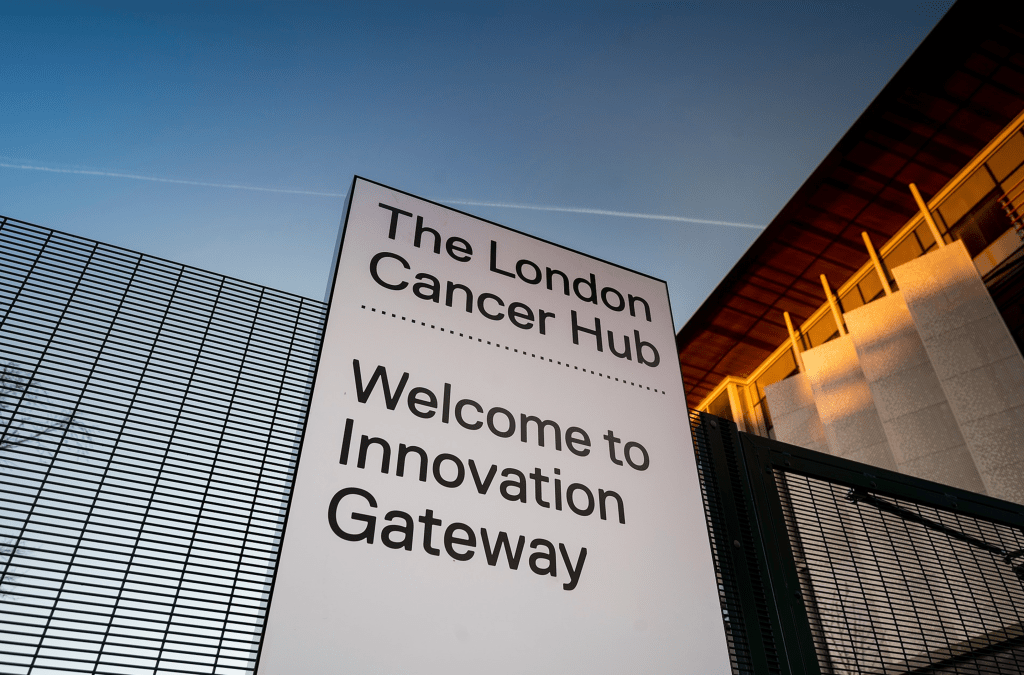
How all this relates to the London Cancer Hub
The LCH is undoubtedly at an early stage of its evolution as a single entity, so I would expect some of these notions to apply, albeit maybe not in the specific ways that they apply to disease. And if I think about my experiences of organisation development I can certainly draw parallels.
Intransigence, for example, is something that I definitely came across at the BBC – or at least it felt that way to me. It seemed that any number of people could make any amount of effort to change things – to reduce staff numbers, say – and yet the organisation would seem to go its own sweet way and somehow, despite reductions and redundancies, there always seemed to be the same number of people working there from year to year and onwards.
Plasticity too has a resonance in this respect – for me it equates to how far an organisation can adapt its ways of working without fundamentally changing its structure or identity (something that might feel more like a mutation).
However, these specific concepts have not captured my creative imagination for some reason in themselves as a basis for artwork, though they are definitely informing my thinking. My next post in this series will, on the other hand, focus on some of the concepts that i have started to investigate creatively.
 GLASS BODIES