Many things I learned from sharing…

The ‘official end date’ of my residency at the London Cancer Hub was 31st January, and that day I held a ‘closing event’ at the ICR. Although to be honest, I will continue to work on these themes and use the learning from the residency in the immediate and the long term future, so it doesn’t really feel to me like the residency has come to an end!

There were multiple purposes to having the event. I wanted the opportunity to share back about how the residency had progressed with those who had contributed, to let them see the tools that I had used to make sense of the experience and to show them some of the prototypes and the samples that I had created as part of the work. I also wanted to introduce others at the ICR (and potentially across the LCH) to the residency as obviously not everyone had come across me or my research. The location near the ICR reception and cafe would help with that. And finally, it would be a great chance for me to gather feedback from people seeing this work for the first time.

I was delighted that I was able to do all three things. During the course of the event, which lasted about 4 hours, around 50 people stopped to look at the work and to talk, and many more wandered by. I had surprisingly in depth conversations with about 30 people. It was really fascinating to be able to gauge and discuss people’s reaction to the work and the process. I also found out more about some research and support roles at the ICR that I hadn’t known about before. 

Below I have summarised some of the things that struck me from the many conversations I had with people visiting my work.

Representational vs metaphorical vs something else?

One very interesting strand of conversation was about how far the pieces were intended directly to represent the processes of a specific element of the cancer ecosystem. I talked about how, from my perspective, I have drawn out ideas, themes and metaphors from the discussions I have had, that I have experimented with these ideas and themes in different ways, but that I am not aiming to illustrate scientific processes.

Several people asked me what the base sphere structures represented. I explained that I think of them as potentially being any of: abstracted cells, abstracted tumours or abstracted bodies. I also observed that spheres are often the starting point for my work. I ended up in an interesting conversation about how organoids look (organoids are structures grown in the lab that have some characteristics of real organs and are therefore useful as an alternative to plain medium), and concluded these pieces could also represent abstracted organoids. To me it feels quite important that they could be any of these simultaneously and are are not specifically one thing or another. I like the idea that people can take meaning from them in a way that makes most sense to them. 

Another conversation about how far the work was representational centred on my choice of black for some of the dendritic patterns and the ‘cells’ themselves. I said that I had been inspired by the convention around extreme hypoxia being very dark or black. I was challenged about this in relation to the fact that the vessel growth, being on the outside of the structure, would surely be red (highly oxygenated) not black. My position was – and is – that I am not creating something literal, and that, even if i decided to do that, these samples were anyway potentially components and I was unclear at this point whether they could be inside another structure or how they would be grouped. And, of course, the structures themselves, despite the fact that I sometimes refer to them as cells, are not in any case determined (see above), and therefore it is impossible to be ‘accurate’ about a representation. 

This whole conversation confirmed categorically for me that for me this work is not intended to be representational of any specific scientific process or entity and that the pieces are not designed to be illustrative or ‘correct’, Instead my aim is to draw on ideas, present them visually in different ways to stumulate thought and questioning. And whilst maybe I will convey some of my intention and thought process through the pieces, I also want to allow people to interpret the pieces according to their own experiences. I am mindful, for example, that some of my inspiration comes from patients as well as scientists, and that I have deliberately been pursuing their subjective and highly individual imaginations to inform our conversation. However, I need to keep in mind is how far the pieces – in their context of the cancer ecosystem – may be taken as if they are representational and what this might mean for how they develop and are displayed.

I was also asked about the Winged Thing and whether and how the metaphor might be explained. Would I have a caption or a label if I was exhibiting this in another context? I am to some extent undecided on that, and the context would itself be key. These pieces a) are prototypes and b) might be used as part of a composition and c) may yet change signficantly in their final incarnation, and with these factors in play, that is not a decision I can take at this point. However, I do think that if I want people to understand the metaphor specifically as mechanism of cancer then an explanation either as part of the artwork or explaining the artwork alongside would need to be a consideration.

Cultural references

I was surprised that several people referenced films when describing how they thought about some of the pieces. Star Wars and also Harry Potter’s Quidditch ball came up when talking about the Winged Thing. Spider Man and his black suit in Spider Man 3 came up in relation to the ‘tar’ overgrowth piece, particularly in connection with the idea of being gripped by something you can’t get out of.

Aesthetic and/or emotional impact

One of the things I was particularly interested in getting feedback on was whether these pieces created any emotional impact. Sometimes this came up spontaneously in conversation, and other times I raised the question of how people felt when looking at them as part of a discussion.

It seems to be having taken stock, there were a wide variety of responses. A couple of people said that they appreciated them aesthetically but did not have any particular emotional reaction. Several times people reacted to the largest dark piece and the tiny black piece by finding them ‘menacing’, or ‘threatening’, or ‘sinister’. These reactions mirrored the response I got from the Art for Social Change artists too, with whom i had previously shared some images; some people found them quite ‘shivery’ whereas others are unmoved. Very interesting. 

One reaction I had was from a PhD student studying pathways in sarcoma. He said that he found one of the pale pieces much more sinister than the dark ones, as the growth around the outside was much harder to differentiate from the body of the piece – from his perspective, cancer is like that – hard to discover, hard to separate from the body, stealthy. We talked about how cancer is so much part of you, and I resolved to think about this more going forward as it chimes with my feelings about how cancer is intimately part of one’s own makeup and particular to you as an individual.

Also as part of the exhibit, I had prepared an exercise with ‘lace’ or ‘lattice’ piece. I asked people to jot down a word or two about what they thought when they looked at it, vs what they felt. Here is the outcome of some people’s contributions. An interesting mix and once again food for thought.

Colour palette

Many many of my visitors asked me why I had chosen the monochrome palette that I did for these pieces, and I explained as above that the starting point had been hypoxia. However, I got a strong feeling that people would be interested to see these or similar pieces with some colour. It set me thinking about whether I would too. Perhaps the next iteration will feature some other tones?

Two ecosystems side by side?

One of the more complicated things I ended up reflecting on as a result of the conversations I had about the project was the ‘success’ or otherwise of looking at these two ‘ecosystems’ side by side. This is something I have been wrestling with throughout the project and talked about in my research interviews also. At this event, I was challenged about whether the LCH could really be considered to be an ecosystem in any way beyond the fact that anything on earth could be considered an ecosystem. Wasn’t it just, like most things these days, an example of a network rather than an ecosystem? 

On this point I would argue that the LCH in fact is more of an ecosystem than, say, a network of aeroplane routes. The LCH is an example of a social system that is developing in an environment, where different groups of people react and change as a result of their interactions with each other and their environment. Some gain useful resources, make interesting connections and thrive, others don’t. In my view this can happen both in organisational and individual levels. So from my perspective, the metaphor of an ecosystem is a useful one to understand how the LCH might function and develop, and that is a matter of importance to those who believe that bringing the London Cancer Hub together is more than a set of buildings on a site and potentially could provide opportunities to collaborate more or better with the goal of preventing and treating cancer. 

At the event, I explained to people that a central question for me was to understand what could be learned from the exercise both from comparing and contrasting the ‘ecosystems’, and also as to how the two different systems might each have a place in the resulting artwork. I am coming to the position that ideas from the cancer ecosystem can be used quite successfully to interrogate the state of play with the London Cancer Hub but not necessarily vice versa. Using the ecosystem metaphor allows one to approach the idea of bringing organisations together in a system from different perspectives and ask new questions. What are the pathways, signals, and structures that are being created? Where are the areas of toxicity? How far do those work in a similar way to the biological systems? I am sure one can use these questions to help continue towards developing the LCH as a healthy, constructive and creative place to work together. However, it is much harder to see how contrasting the two systems works the other way around, using metaphors from the LCH to inform the research into the cancer ecosystem. And, to be honest, I am not sure I set out asking the relevant questions about how the LCH functions tso that one could apply the metaphors from the organisational, social and spatial environment of the LCH to see the cancer ecosystem differently. This is all part of the learning for me, and something I can set my mind to, going forward.

This event brought the formal part of my residency to an end, and in terms of this blog, it only remains to draw some of these ideas together in my next and last post on this project.

Collected images of the artwork prototypes

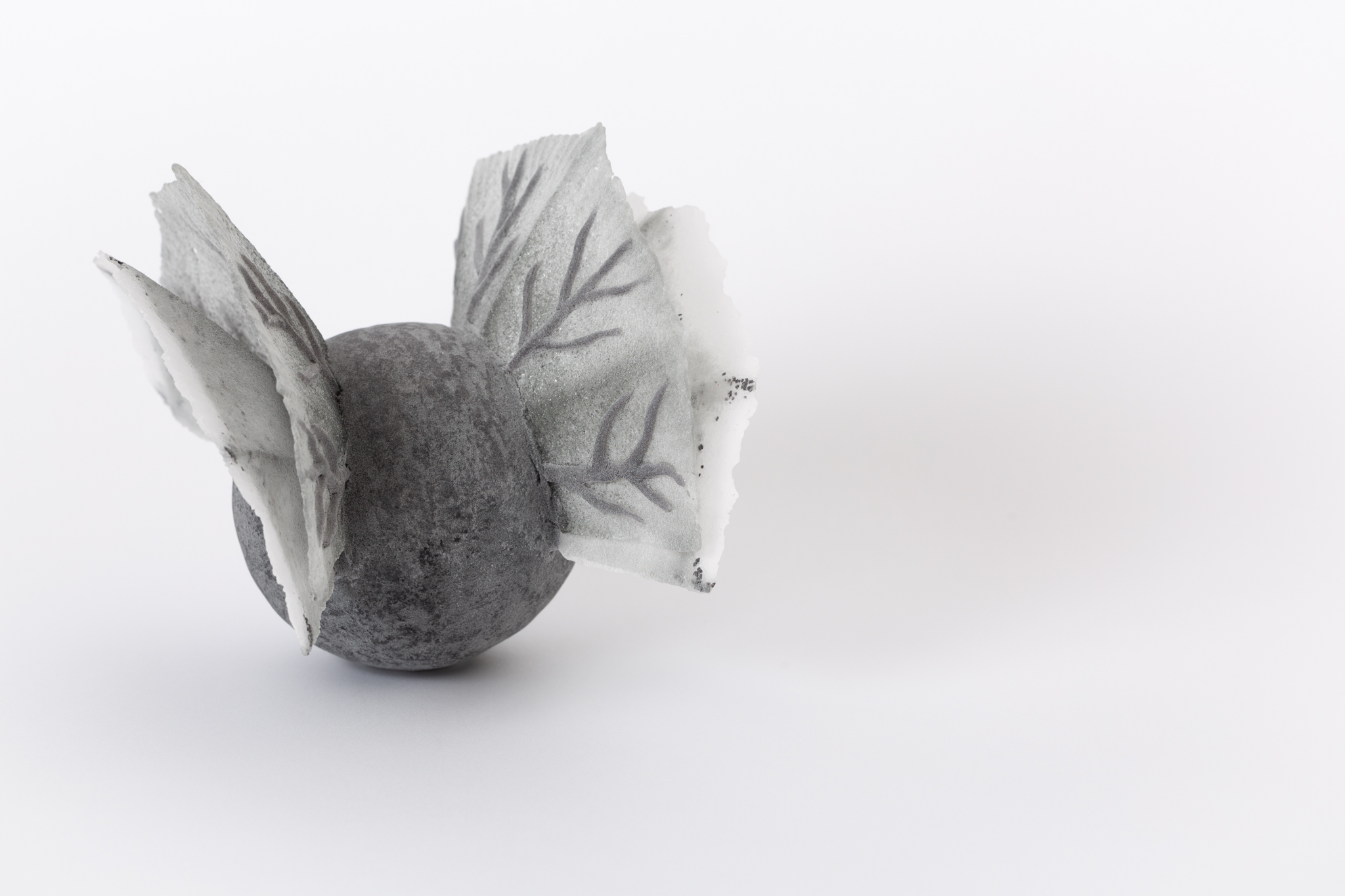
As the residency draws to a close, it’s a good time to share images of some of the prototypes and samples that I created alongside undertaking my other research. I always like to document my work and also to be in a position to provide high quality images where necessary, and I can’t do that with the snaps that I take myself. So instead I rely on my wonderful photographer and friend Robyn Manning. Before finishing the residency I took some of the samples and prototypes over to her studio to photograph, and here are the results.

Visualising cancer (2)

Previously I wrote about my interest in how we visualise disease within our bodies and that one of my priorities as part of this project was to talk to people for my research who were, or had been, being treated at the Royal Marsden.

I was lucky enough to get the chance to talk to a small number of patients currently undergoing treatment or under observation. I am not recounting any medical detail that we discussed here; obviously I want to maintain the privacy of those who spoke with me. Rather I am reflecting on some of the more abstracted discussions about imagining disease that served as inspiration and provided visual ideas to investigate or develop further. And alongside these reflections are some brief observations about how the London Cancer Hub is experienced for some of those being treated there.

Visualising science

A couple of the patients I spoke to were particularly focused on understanding the science of their experience, although from different perspectives. One had been involved in research professionally, and continued their professional interest. Another was moved to research and understand as much as possible about the scientific mechanisms and processes governing their current experience. Both found the scientific information that they engaged with had an impact on how they imagined their disease. One had a detailed understanding of anatomy and felt that imagination and knowledge were generally in accord, whereas others had an imaginary world that might be influenced by their knowledge, but was not entirely at one with it. 

Visualising cells

In at least one interview, we spoke at some length about visualising cells and about imagining how ‘cells go rogue’. As well as discussing the scientific mechanisms as far as we understood them, more of the conversation was dedicated to how cells might appear in our minds’ eye. One participant described their sense of a small, dark, translucent, hollow globe that represented the cancer cell in their mind’s eye, a cell that was somehow coated in invisibility to the immune system. This contrasted with their vision of healthy cells as a beautiful pink, full of delicate and intricate structures.

Visualising tumours

I asked several of my interviewees whether they had visualised their tumour, or indeed seen images or scans of their tumour and mainly they had not. We discussed how they imagined their tumour within their body. We also discussed the presence or absence of a tumour that you could feel from the outside of your body and the impact that had on your imagination, for example, thinking about the convex and the concave. One person described initially thinking of their tumour as smooth like an egg, but then reassessing after being told that what identified it initially as potentially malignant was that the lump had broken up when excised. 

Because of this, eggs and broken eggs became really interesting metaphors for me that i would like to explore going forward. Eggs are both a site of growth – usually with a positive connotation although not always – and are also often used as an example of extreme fragility. These make powerful ideas to experiment with. I am planning on making a series of eggs and also playing with the japanese idea of kintsugi – the practice of highlighting imperfection through visible mending – alongside such pieces. 

Visualising connections

I spoke to all my interviewees about the London Cancer Hub in terms of any expected or unexpected connections they had experienced through being part of a larger entity than the Royal Marsden itself. Several people mentioned the relationships within the RMH between Chelsea and Sutton. Others discussed referrals from other medical institutions and the relationships between their local hospital and the RMH.

With more than one patient I discussed their experience of using the Maggie’s Centre on the LCH site. They were extremely appreciative of the support they received from Maggie’s, and in particular the patient groups that Maggie’s facilitates which connected them with people who were going through or had gone through similar experiences. 

With one patient in particular we went on to explore the idea of all the connections in a more abstract way. We spoke of bubbles, ripples, radial relationships and concentric circles. They spoke of Boolean searches and intersecting search terms and I replied with Venn diagrams. One of the striking features of the London Cancer Hub is not only the relationships within it but also so many relationships that connect it to other institutions, organisations, groups, both formal and informal. This conversation brought home to me the extent of the network that the LCH sits within.

Visualising ecosystems

We mostly didn’t get on to talking about the comparative ecosystems of cancer and the London Cancer Hub, but there was one exception which I want to record here because I particularly want to come back to it in thinking about sculptural compositions in relation to where this work takes me in the future. This was a conversation where my interviewee observed that one comparison between the two was that cancer was a system characterised by proliferation and spread, whereas the LCH would be characterised instead by unification and concentration. Somehow this had completely escaped me up to that point. It was, and remains, a very useful and potentially productive observation for me to carry into my artwork.

The LCH visiting experience

When I spoke to patients about their experience of being at the LCH as a visitor there was pretty much consensus that their experience was not of the LCH at all, but of the Royal Marsden. Mostly the RMH was the only place they went to on site, but even those who visited Maggie’s were not conscious of any broader idea of collectivity than that Maggie’s was co-sited with the hospital, as Maggie’s Centres generally are.

I asked all the patients i spoke to whether they were aware of other organisations on site. In most cases we immediately got onto conversations about getting lost. More than one patient had become aware of the ICR by entering the site through the ‘wrong’ entrance and getting lost. More than one patient had also got lost trying to navigate the site to find Maggie’s from the RMH. Another had seen the signs for the London Cancer Hub and was confused as to what that was.

It is clearly early days for the LCH and its also true that patients do not necessarily need to know that the hospital they are visiting is part of a larger entity, but it is something for the LCH folk to think about going forward. More than one patient mentioned the benefit of being part of a hospital involved in clinical trials and at the forefront of treatment and the RMH’s alliance with the ICR and other organisations at the LCH might be reassuring or helpful in some other way. 

And more than that, the site is confusing, signage is not sufficient or consistent and people get lost. It was oddly comforting to know that it was not just me. But it points to back to the lack of coherent planning across the site that is currently a feature of the LCH.

Other kinds of maps

Towards the end of the residency, one of the things I wanted to do was to share back with those who had contributed some of the process and outcomes of my time working at the London Cancer Hub. So we planned an event at the ICR to do just that.

I was finding it really complex to work out how to convey all the thinking that I’ve been doing during the residency, and then my fabulous colleague, Siobhan Kneale, who has been working with me on behalf of Sutton Council and Sutton STEAMS ahead, suggested putting together a mind map. 

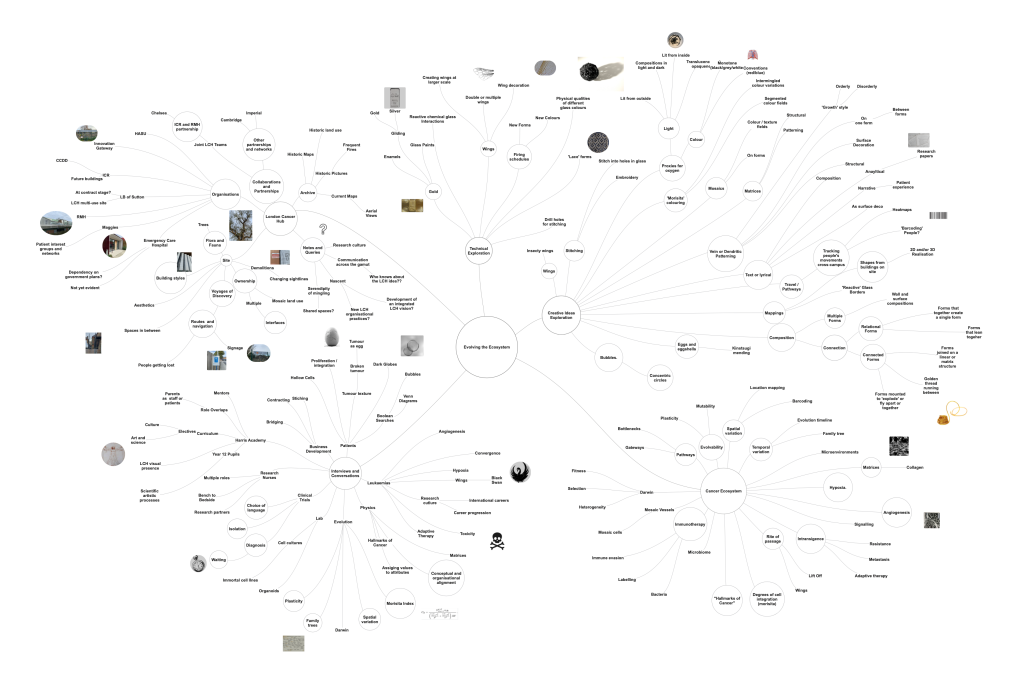
I did, and it grew, and grew, and grew. Here it is in its semi-final form. It has proved an invaluable way to organise my ideas and to record my thinking. It doesn’t follow a single type of categorisation – the joy of a mindmap is that I can set creative ideas in the same context as noting ideas about the two ecologies and then branch into glass techniques and technical exploration. It is very much a personal record rather than any form of analytic, and highlights not everything I learned but those things that stuck out to me.

I also put together a map of metaphors according to how closely I found them to apply to the London Cancer Hub, the Cancer Ecosystem or both. Not a scientific process, more a finger in the air type of approach, but it will be useful to me nonetheless in capturing my thinking and shaping potential artwork.

I prepared prints of both of these for the Closing Event to share with participants and anyone else who might be interested…

Things with wings

When thinking about all the metaphors and how my artwork might develop I was immediately struck by the metaphor of cancer cells developing ‘wings’ as they transition from single tumours to metastatic disease. I knew it would be technically challenging making a piece in glass that reflected to any degree what I was visualising in my mind’s eye, but I thought I should try and at least capture something of the feeling by ‘going for it’ and seeing what I could achieve.

To understand the challenge, it’s necessary to share a little about how glass behaves when it’s heated. To make my pieces in ‘pate de verre’ (literally paste of glass), i make a paste from crushed glass or glass powder and apply it to a mould. This is the process you can track looking at my previous post about making ‘cells’. When the glass is then heated in a kiln, the powder or crushed glass fuses together in the heat to make a single surface. What holds it in position is a delicate balance between the level of heat and the structure of the mould. Too much heat and it will drop off the mould, too little and it won’t fuse and will return to dust.

When trying to create ‘wings’, if they are freestanding, they will sag in the heat and eventually drop onto the nearest surface, which might be the body of the cell or might be the shelf of the kiln. Luckily, earlier in the year I had learned a firing technique of firing pieces in a bowl of powder (sand or aluminium oxide) which could support the wings while the glass fused. For this i am grateful to the amazing glass artist Saman Kalantari. Here an image of some pieces I created by combining this firing technique with my own method of pate de verre.

However, what I wanted to achieve with this project was more ambitious technically in terms of the scale and form of the wings in relation to the ‘body’. My initial sketch for the piece is below.

As I’m not super comfortable in two dimensions I went on to make a 3D maquette out of polystyrene and wire mesh. You can follow the whole process through the flow chart below…

THe chart makes it look relatively straightforward, but I can reveal that it was not! Getting the firing right required multiple attempts, with the piece going into the kiln in one way or another about 5 times. Luckily, I wanted the piece to look a bit ‘distressed’ as this is entirely in keeping with the ideas of the cells that emerge with ‘with wings’ from the ‘cell graveyard’ within a tumour. The cell that emerged was a bit battered from all it had been through, but proved that it is possible to make a double-winged entity where the wings have a significant area in relation to the size of the ‘body’ of the piece.

Here is an image of the piece once I had brushed it off and done a bit of coldworking - that is, finishing edges and surfaces with grinding and polishing tools.

Experimenting with angiogenesis (2)

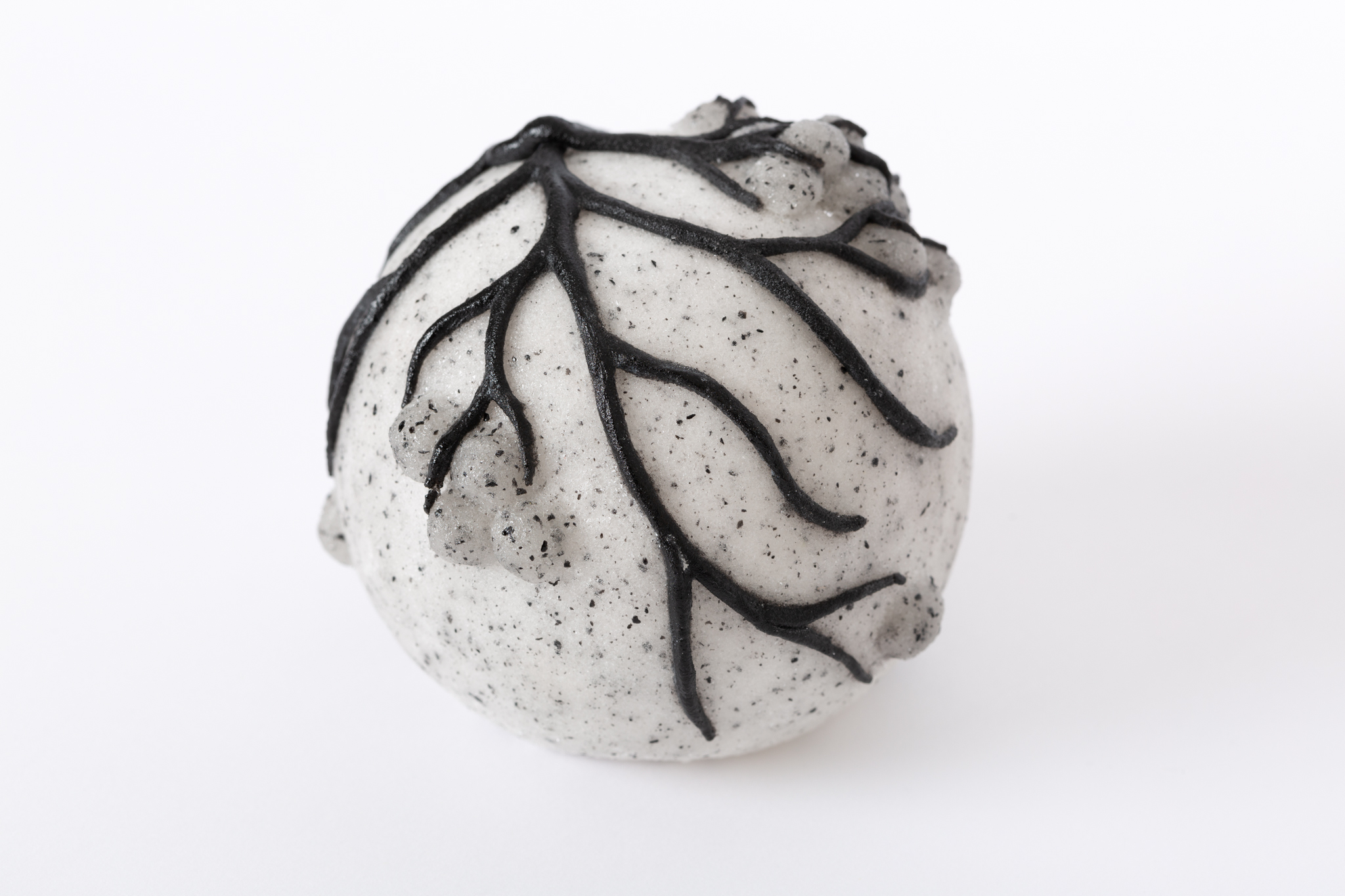
After making the ‘cell’ structured from ‘veins’ I tried a number of different approaches to applying vein-like patterns to the exterior of a cell structure. I wanted to try degrees of visual order or chaos, and to see how these effects looked in different tones – dark veins on pale background, pale veins on pale background, dark on dark etc. I also wanted to assess impact of variations in size. So i made a selection of other ‘dendritic’ cells to compare with the initial cell described in a previous post. Here are some images of the making process for these.

And here are some images of the finished cells

I also made a small sample of a potential flat panel featuring an image of a tangle of blood vessels with gilding added, representing something of a golden thread or pathway through the tangle. I went on to make three larger sample panels which became a series of three with the gilding ‘moving through’ the vein tangle and spreading across the panel.

Panels waiting to be fired for the first time before gilding

Working with different approaches to some of the same theme has felt very productive for me. I have got to assess creatively and technically which types of surface are most successful and most expressive. I also plan to gather some feedback from others as i begin to share the work to get a sense of what the different patterning and finishes convey to those who see them…

Finished angiogenesis text panels

Experimenting with angiogenesis (1)

I have already written about my interest in angiogenesis as a process that forms part of the cancer ecosystem and that potentially functions as a metaphor in the LCH context (see Concepts and Metaphors (5)). It has been fascinating to look at images of the blood vessels that grow to support tumour growth. and equally interesting to see how clearly related the visual qualities of blood vessels from a tumour are to growth patterns observable around the LCH site, such as amongst the trees and ivy growing near the demokition site and close to the Royal Marsden.

On the left, an image of tumour blood vessels. Centre and right, images of trees and ivy on the LCH site.

These types of images were my starting point for making some glass samples and experimenting with using dendritic growth patterns as both structure for glass cells and for decoration.

And so, angiogenesis has emerged as a focus for my initial creative exploration. I have long been interested in creating vein-like, dendritic structures and decoration, so this is an evolution rather than complete change of direction for my own creative practice.

I decided to start with the basic form of the sphere, partly because i enjoy working with that form, and partly because to me the sphere is suggestive of the shape of a cell (regardless of the fact that not all cells are spherical). 

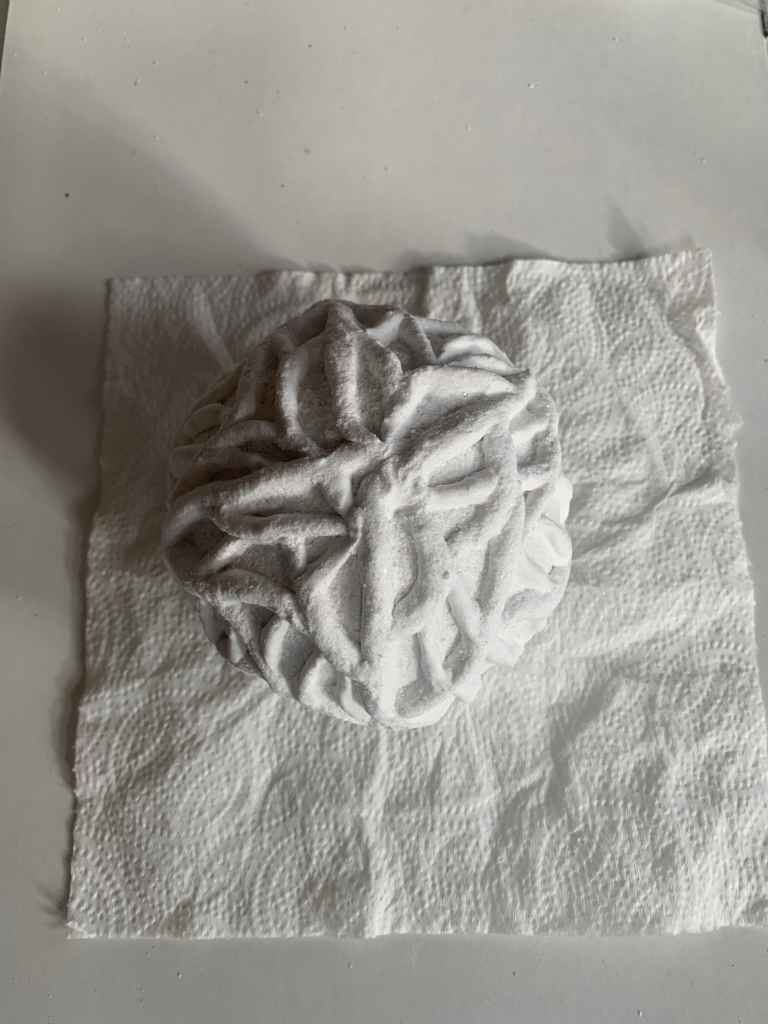
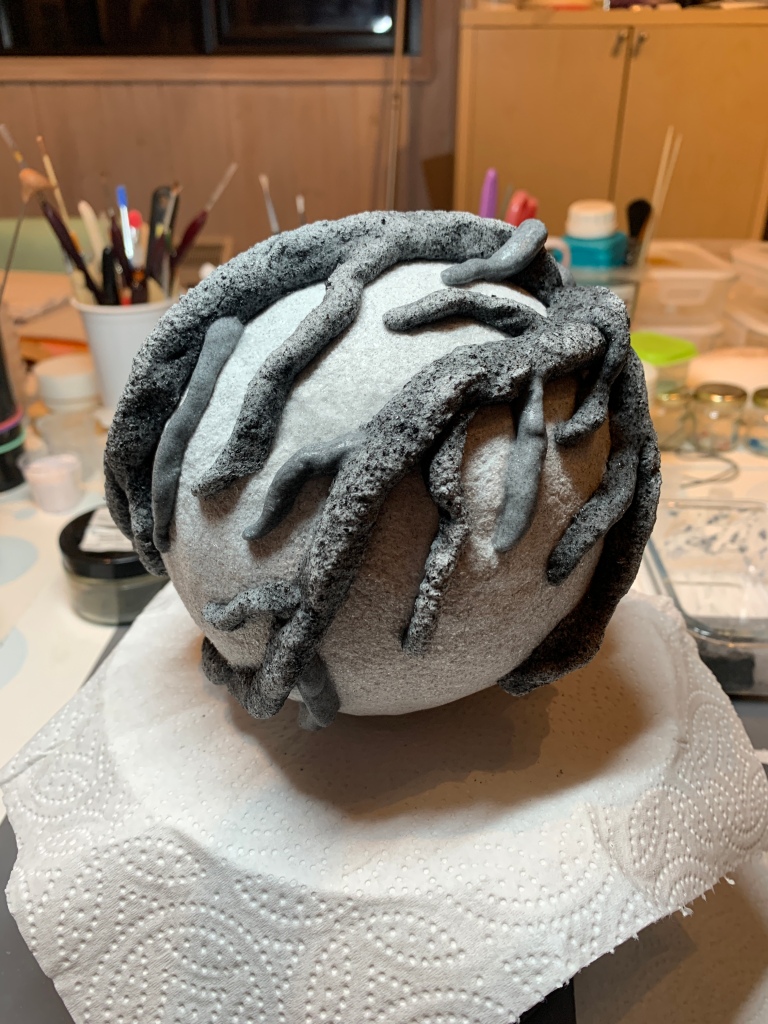
My first idea was to try and construct the form as a whole just from ‘veins’ to see if i could form the cell structure that way. The following images track my progress along that path.

The first line of images above shows the initial ‘veins’ of glass paste that build the structure of the glass over the mould. The second line of images shows a later stage where more veins have been added and interwoven. I was aiming at an outcome that was somewhat evocative of the growth patterns in the images of the tumour blood vessels and also the tree and ivy growth.

In the kiln before firing

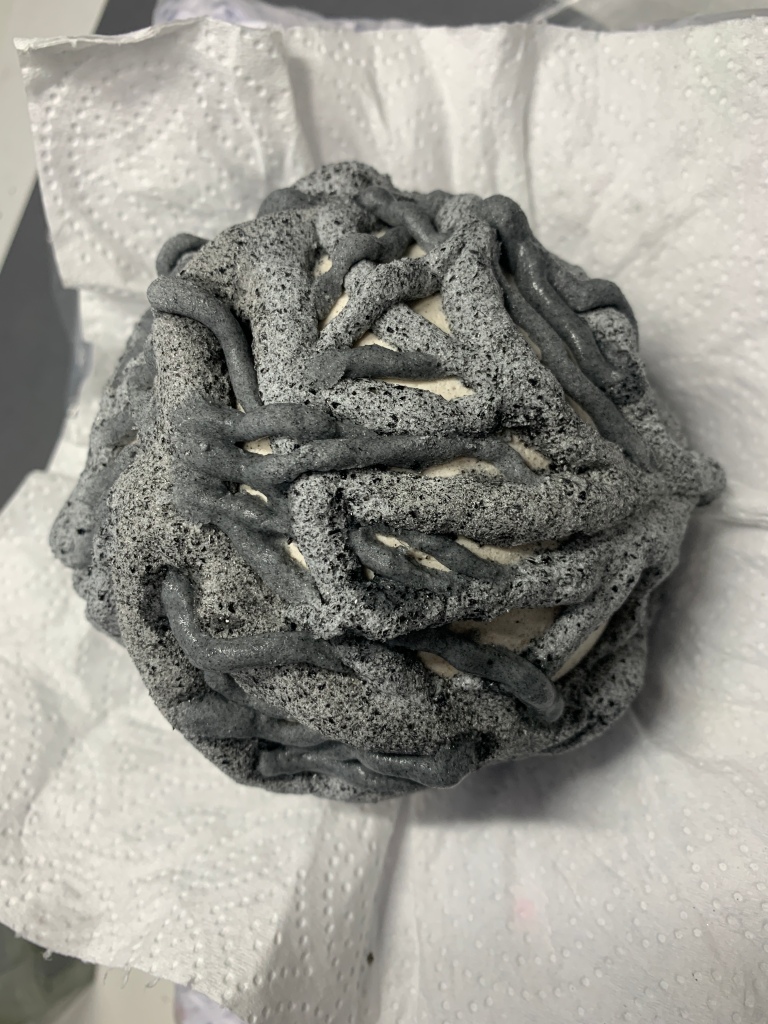
This is how the piece looked when it went into the kiln for firing. Glass paste shrinks considerably when it’s fired, so I was expecting the veins to be more slender when they emerged. From the technical perspective I was concerned about whether the structure would be strong enough and stable when it emerged as the shrinkage can also cause the glass to pull away and disconnect or to crack and break. From a creative perspective I wanted to see how the veins looked after firing to see if they (still) evoked the tumour and growth patterns.

This is how the finished ‘cell’ looks below with a bit of directional lighting. Luckily the firing went well and the piece emerged intact. As a sample or prototype I am very happy with how it’s turned out. It was very time consuming to make – more so than the samples of dendritic cells that i made subsequently, as the lack of underlying structure for the veins made the whole thing more complex. I also felt that the shrinkage of the glass made the piece slightly less evocative than it was pre-firing, but to some extent this could be changed in subsequent pieces.

One thing I should add at this point is that this – as a sample or prototype – is not intended to be a standalone piece. My intention was that it could be a model for a component of a composition of cells, potentially some in light, some in shadow. I knew also that I wanted to experiment with working in a pale colour, probably white, and making vein structures that were also more ordered, less chatotic. So that’s what I did next.

Visualising cancer (1)

Over the years I have become particularly interested in how we visualise cancer in our own bodies. When i found a lump in my neck in my late twenties, I had a visual image of what was going on that probably had nothing to do with the science of the thyroid and everything to do with how i was feeling and how my mind’s eye works. Initially I received the diagnosis that the lump on my thyroid was benign – at which point I stopped thinking about it so much. A revision of the pathology results and a reclassification of the diagnosis to a malignancy focused my attention very much back on what was happening in my body. I can still recall much of how I visualised the progression from feeling the lump in the first place though the initial diagnosis and then during further treatment.

Since i started to pursue art as a career I have followed this interest in how we imagine what’s taking place in our bodies when we are well and when we are not. I absolutely don’t expect that everyone’s visualisation style will match mine and I also don’t imagine that other people’s visualisation of what’s happening inside them will necessarily match to the science of their condition any more than mine did – though it might. For me there was much too much emotion influencing what I ‘saw’. Nonetheless – or more probably because of that – I am intrigued about the imagery that populates our minds when something changes in our bodies or we’re told that something has gone wrong.

Last year I was lucky enough to work on a project that allowed me to partner with an individual to explore with them their experiences of cancer and chemotherapy and how it played out in their own mind’s eye. The result was several pieces of artwork that reflected their sense of how cancer and chemotherapy worked its way through their body. For this project I wanted to continue to involve people dealing with cancer themselves, finding a way to connect with people who are interested in the project; patients are, after all, the reason that the London Cancer Hub exists at all. Thanks to the support of the Patient and Public Involvement and Engagement Team at the Royal Marsden, and their platform, the Cancer Patient’s Voice (see previous posts) I was able to get in contact with some patients who had expressed an interest in taking part.

In the mind’s eye…

As a result I was lucky enough to speak with several patients who were undergoing active treatment or who were under ongoing observation. I had fascinating and wide-ranging conversations with all of them about their treatment, their experiences of the LCH and about how they visualised their disease, both in terms of their personal experiences and in relation to the science they had learned as part of their treatment. Rather than going into detail about each of the conversations, in my next post on this theme I am going to consolidate some of the outcomes of our conversations.

Each of the people who talked with me were generous enough to give me permission – despite the very personal nature of their stories – to use their observations and experiences as inspiration for artwork and potentially within the artwork itself.  I am enormously grateful to all of them for their generosity and help.

Metaphors and concepts (5)

I have saved some of the ideas that have proved to be at the heart of my creative research for the latest batch of concepts to emerge from the conversations and research into the cancer ecosystem. And following on from this post I will start to share some of the creative and visual ideas i have been working on – but without posting these concepts first, they would make much less sense. So here goes!

Hypoxia

A state of insufficient oxygen. This can happen at the centre of a tumour when the blood vessels do not penetrate to the centre of the tumour, and tends to start happening once the tumour gets to around 1cm. In medical convention, fully oxygenated blood is represented by the colour red, less oxygenated by blue (thinks arteries versus veins). Severely hypoxia tends to be represented by dark blue or black.

In the middle of a tumour the environment for cells is often both hypoxic and toxic – cells that survive these conditions are preselected to be tough, resistent, intransigent.

Angiogenesis

The process by which new blood vessels form from existing blood vessels. This is initiated through cells signalling that they are becoming hypoxic. Cells in cancer tumours send lots of these signals and new blood vessels then begin to grow around and into the tumour to try and bring oxygen to the hypoxic cells. The blood vessel growth can be very disordered and excessive as compared with normal vessel growth. The Childhood Leukaemia team shared this image with me of blood vessels from a tumour.

Mosaic Vessels

Occasionally blood vessels that grow in cancer tumours as part of angiogenesis include tumour cells as part of the blood vessel structure itself, so that ‘normal’ epithelial cells and abnormal cancer cells form the wall of the blood vessel together.  These are mosaic vessels.

“Morisita Index”

The Morisita Index is drawn from statistical study of populations and is a measure within a population of how mixed up or separate the different elements of a population is. In relation to the cancer ecosystem, it measures the degree to which different types of cells – eg epithelial cells, immune cells, tumour cells – are aggregated or segregated. As well as being applied to the nature of different tumours, the index can also be applied to human populations, for example, in a working environment, to express how combined or segregated they are.

Liquid Tumours

I have always thought of cancer tumours as something solid. Some hard and unyielding, some softer or floppier, but I had not really considered that tumours could be liquid. Whereas, solid tumours are indeed solid and lumpy, liquid tumours, eg leukaemias and lymphatic tumours, flow.

How all this relates to the London Cancer Hub?

In some ways the easiest concept to apply directly to the LCH is the Morisita Index. In fact, in conversation with one of the researchers who introduced me to the Morisita index, we discussed how he had been drawn to work at the ICR by the multidisciplinary nature of the teams there. I observed that this seemed like a Morisita measure in the workplace…

Other concepts here are less obviously applicable to the LCH directly. Nonetheless I feel that they have relevance to the work i am doing in relation to the LCH as well as the cancer ecosystem. Hypoxia and angiogenesis are to be interpreted literally as part of the cancer ecosystem, but they function rather well as metaphors in the context of the LCH. They are also potentially visually very interesting.

Taking specifically the idea of hypoxia and its relationship to angiogenesis, here is some of my thinking. In the body there are areas that require more oxygen; in organisations there are areas that require more resources or attention. In both cases these call for more connectivity and greater flow though – with the cardiovascular system through the growth of blood vessels, in terms of organisations perhaps one can read stronger relationships, more interaction, greater communication. Where an area of a body is cut or hurt, new blood vessels grow. For new areas of organisation, it is may be necessary to grow new routes of communication, new career paths, new sources of resource. To which you can equate angiogenesis.

These metaphors also work for me in relation to an issue that has troubled me in running the parallel between ideas about the evolution of an ecosystem at the LCH and the study of the cancer ecosystem. Cancer, obviously, is profoundly threatening to the organism. whereas the developing ecosystem at the LCH, one hopes, is going to result in a healthy symbiosis, a mutual thriving. I find the ideas of angiogenesis helpful in relation to this, in that angiogenesis can be a system that functions in a positive, orderly way in a healthy body, bringing oxygen to growing or healing tissue. However, in cancer it can also ‘overgrow’ into a support system for malignancy, playing a role in metastasis as a route through the body. So you can view angiogenesis from both a functional and dysfunctional perspective, as potentially ordered or disordered.

From both the conversations I have been having and my reading, I realise that angiogenesis is no longer the newest focus of research. It was very much at the forefront in the 1990s and 2000s when an active research priority for curing or preventing cancers was developing and deploying angiogenic inhibiting drugs. However, it remains a central part of the cancer ecosystem, and while i was researching at the ICR the Childhood Leukaemias team published several new papers suggesting that new understanding of the role of hypoxia in TP53 mutations could really illuminate what’s going on when cancers metastasise,

Metaphors and concepts (4)

Today I am going to dip in to some concepts that aren’t quite as closely related to ecological mechanisms from the cancer ecosystem. They have come up from a variety of conversations with people from a range of settings – from research science to business development discussions for example. Instead of separating these into the cancer ecology concepts and their relationship with the London Cancer Hub as I have done previous posts in this series, for this post where the concepts are less ecological, i am mixing things up a bit.

Barcoding

When talking about some of the data that informs the understanding of cancer evolution, it was explained to be how different cells get ‘barcoded’ so that their behaviour and characteristics can be examined, dependent, for example, on where they are located within a tumour. This enables the team to analyse behaviours or outcomes according to the cell location.

The idea of barcoding made me think a lot about how people are positioned and move around the LCH site and the nature of their experience, depending on where on the site they are based. Most of the people I spoke to spend most of their time in a single location for their work, or certainly mainly within one organisation’s buildings. When I asked about using other parts of the site, most of the people I spoke to kept mainly to their own area. However, a few travelled across the site – between the ICR and RMH for example – on a regular basis, and others talked a lot about travel to and fro from other partner organisations such as Imperial, possibly more than within the LCH. I thave oyed with the idea of making an artwork based on tracking people’s movements around the site. I think it would be illuminating – tho i am not sure how keen people would be to take part!

Securing

We had a conversation about patient medical data, its sharing, safekeeping and its absolute crucial role in research. The day of this conversation, an article had been published in the Guardian about how UK medical data was – or was not – being protected, and how much research is impossible without access to large data sets that rely on individuals being secure about how their information is shared. (Articles of this nature are being published every week, reflecting major ongoing developments in this sphere).

Security is an obvious concern in relation to different parts of the LCH and movement around the site is not unrestricted, no doubt for some very good reasons. The ICR, for example, is all access controlled, so that only staff or approved visitors can access the buildings. The Royal Marsden obviously needs to be accessible to patients so there are many spaces that can be accessed without restriction. However, I visited several to office spaces where you needed a pass to get in.

All this set me thinking, are there parallels that I can investigate between the security of medical data and the security of the site? Something to think about, though I have no idea yet where that might lead….

Bridging“, “Stitching” and “Translating

These ideas came up in particular when talking about the Innovation Gateway and the development of the new multi-use site that could also house larger biotech or pharma-type companies, and the relationships between the research activities and treatment facilities focused in the ICR and Royal Marsden with the commercial ompanies housed at the Innovation Gateway or on the new site. (Confusingly to me, the new development site seems often to be referred to specifically as the London Cancer Hub on its own, without meaning the whole inclusive site covering the ICR, Royal Marsden etc.)

To me the ideas of bridging and translation apply principally to the LCH rather than the cancer ecosystem, and indicate the perceived or actual gap between the focus and/or the operations of the different types of organisations. ‘Translating’ we spoke about literally in relation to facilitating discussions and agreements across disciplines, in particular, for example, between business areas and clinical or research teams. But the idea works not only in relation to the specifics of language, but potentially also translating between priorities and focus as well. ‘Bridging’ fits nicely with all the spatial ideas that have emerged already in the discussions of the cancer ecosystem but works more or less literally on the site too.

Of these three, I think ‘stitching’, for me, has the most creative possibilities – it is literally an interesting way to make artwork. It also seems to me to be an expressive of what might need to happen to create a single site of excellence where the organisations can build effectively on each other’s work rather than operating as separate but physically adjacent entities. 

Plenty of food for thought with all this!