Visualising cancer (2)

Previously I wrote about my interest in how we visualise disease within our bodies and that one of my priorities as part of this project was to talk to people for my research who were, or had been, being treated at the Royal Marsden.

I was lucky enough to get the chance to talk to a small number of patients currently undergoing treatment or under observation. I am not recounting any medical detail that we discussed here; obviously I want to maintain the privacy of those who spoke with me. Rather I am reflecting on some of the more abstracted discussions about imagining disease that served as inspiration and provided visual ideas to investigate or develop further. And alongside these reflections are some brief observations about how the London Cancer Hub is experienced for some of those being treated there.

Visualising science

A couple of the patients I spoke to were particularly focused on understanding the science of their experience, although from different perspectives. One had been involved in research professionally, and continued their professional interest. Another was moved to research and understand as much as possible about the scientific mechanisms and processes governing their current experience. Both found the scientific information that they engaged with had an impact on how they imagined their disease. One had a detailed understanding of anatomy and felt that imagination and knowledge were generally in accord, whereas others had an imaginary world that might be influenced by their knowledge, but was not entirely at one with it. 

Visualising cells

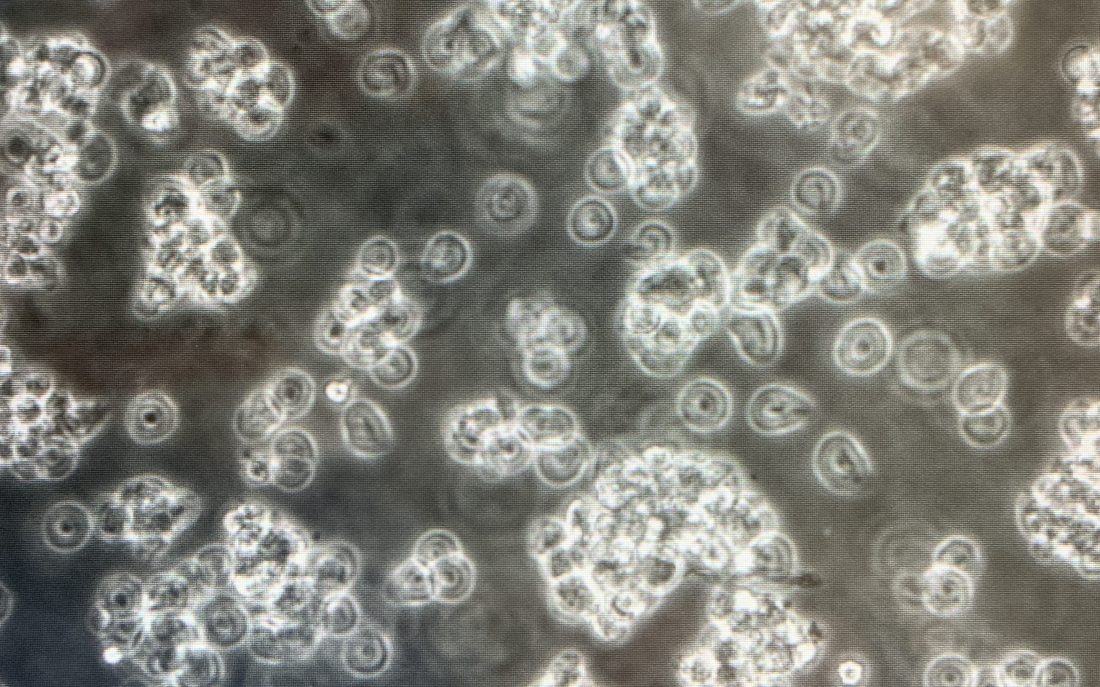
In at least one interview, we spoke at some length about visualising cells and about imagining how ‘cells go rogue’. As well as discussing the scientific mechanisms as far as we understood them, more of the conversation was dedicated to how cells might appear in our minds’ eye. One participant described their sense of a small, dark, translucent, hollow globe that represented the cancer cell in their mind’s eye, a cell that was somehow coated in invisibility to the immune system. This contrasted with their vision of healthy cells as a beautiful pink, full of delicate and intricate structures.

Visualising tumours

I asked several of my interviewees whether they had visualised their tumour, or indeed seen images or scans of their tumour and mainly they had not. We discussed how they imagined their tumour within their body. We also discussed the presence or absence of a tumour that you could feel from the outside of your body and the impact that had on your imagination, for example, thinking about the convex and the concave. One person described initially thinking of their tumour as smooth like an egg, but then reassessing after being told that what identified it initially as potentially malignant was that the lump had broken up when excised. 

Because of this, eggs and broken eggs became really interesting metaphors for me that i would like to explore going forward. Eggs are both a site of growth – usually with a positive connotation although not always – and are also often used as an example of extreme fragility. These make powerful ideas to experiment with. I am planning on making a series of eggs and also playing with the japanese idea of kintsugi – the practice of highlighting imperfection through visible mending – alongside such pieces. 

Visualising connections

I spoke to all my interviewees about the London Cancer Hub in terms of any expected or unexpected connections they had experienced through being part of a larger entity than the Royal Marsden itself. Several people mentioned the relationships within the RMH between Chelsea and Sutton. Others discussed referrals from other medical institutions and the relationships between their local hospital and the RMH.

With more than one patient I discussed their experience of using the Maggie’s Centre on the LCH site. They were extremely appreciative of the support they received from Maggie’s, and in particular the patient groups that Maggie’s facilitates which connected them with people who were going through or had gone through similar experiences. 

With one patient in particular we went on to explore the idea of all the connections in a more abstract way. We spoke of bubbles, ripples, radial relationships and concentric circles. They spoke of Boolean searches and intersecting search terms and I replied with Venn diagrams. One of the striking features of the London Cancer Hub is not only the relationships within it but also so many relationships that connect it to other institutions, organisations, groups, both formal and informal. This conversation brought home to me the extent of the network that the LCH sits within.

Visualising ecosystems

We mostly didn’t get on to talking about the comparative ecosystems of cancer and the London Cancer Hub, but there was one exception which I want to record here because I particularly want to come back to it in thinking about sculptural compositions in relation to where this work takes me in the future. This was a conversation where my interviewee observed that one comparison between the two was that cancer was a system characterised by proliferation and spread, whereas the LCH would be characterised instead by unification and concentration. Somehow this had completely escaped me up to that point. It was, and remains, a very useful and potentially productive observation for me to carry into my artwork.

The LCH visiting experience

When I spoke to patients about their experience of being at the LCH as a visitor there was pretty much consensus that their experience was not of the LCH at all, but of the Royal Marsden. Mostly the RMH was the only place they went to on site, but even those who visited Maggie’s were not conscious of any broader idea of collectivity than that Maggie’s was co-sited with the hospital, as Maggie’s Centres generally are.

I asked all the patients i spoke to whether they were aware of other organisations on site. In most cases we immediately got onto conversations about getting lost. More than one patient had become aware of the ICR by entering the site through the ‘wrong’ entrance and getting lost. More than one patient had also got lost trying to navigate the site to find Maggie’s from the RMH. Another had seen the signs for the London Cancer Hub and was confused as to what that was.

It is clearly early days for the LCH and its also true that patients do not necessarily need to know that the hospital they are visiting is part of a larger entity, but it is something for the LCH folk to think about going forward. More than one patient mentioned the benefit of being part of a hospital involved in clinical trials and at the forefront of treatment and the RMH’s alliance with the ICR and other organisations at the LCH might be reassuring or helpful in some other way. 

And more than that, the site is confusing, signage is not sufficient or consistent and people get lost. It was oddly comforting to know that it was not just me. But it points to back to the lack of coherent planning across the site that is currently a feature of the LCH.
Visual ideas and creative research

Although much of my research has been focused on ideas and concepts, I have quietly been exploring visual and sculptural ideas alongside the intellectual ones. 

So much material has been buzzing around my mind about how I might start to visually interpret and express the concepts and relationships I have been learning about. In the end i have learned that i need to ‘follow my nose’ or ‘go where the energy is’. So i have been following up the ideas that have most grabbed my attention. My frustration is that, with glass in particular, exploring a single idea can take weeks and weeks, and there are so many ideas that the visual and creative research will extend long after the residency period is over.

As I have been progressing through the concepts and ideas and conversations and learning, I know several of the things I want to explore include:

  • Things with wings
  • Angiogenesis – healthy, cancerous or not at all
  • Mosaic cells and mosaic maps
  • Light as a metaphor for oxygen availability and/or for chemical signalling
  • Barcoding and location tracking – mirroring the spatial labelling of cells
  • Stitching and golden threads (literal or not)

And this is just a starting point! I have gradually been developing a creative ‘mind map’ over the last few weeks which I will share here soon, which shows many of the directions I want to experiment with. In any case I will be posting about some of my journeys so far over the next week or two…

The London Cancer Hub – a wilderness or a garden (or something in between)?

As the project evolves(!) it feels like time to reflect on some of the things I’ve learned about the LCH as an entity as well as continuing to update this blog with all the concepts and metaphors I’ve drawn from the conversations about cancer research.

And now that I’ve talked to a variety of folk based at the Sutton site from the ICR, the Royal Marsden and also from the London Borough of Sutton I am both a whole lot clearer and a whole lot less clear on what the London Cancer Hub actually is.

A view across the LCH from the ICR access road to the new Innovation Gateway site

Fundamentally, it seems to me that the ‘London Cancer Hub’ is an idea. It’s not the only example of a ‘hub’ that brings together similar types of organisation in one site with the aim of maximising the potential of the co-sited organisations by placing them together. See for example, this article by UK Research and Innovation outlining collaborations across the UK, several of which include co-location, or this one about the Imperial College White City Life Sciences campus. What makes the London Cancer Hub unique is its tight focus on the science of the prevention and treatment of cancer.

But beyond that simple explanation of a shared goal, I have been struggling a little with what actually binds the London Cancer Hub together, and what differentiates it from other partnerships and collaborations that are aimed at cancer treatment and care. And when I started to delve, I realised that I had arrived with a whole set of assumptions, many of which I am only now becoming aware. And because I am dealing with snapshots, transient impressions and fragments of explanation, which are the nature of the types of conversation I have been having, it’s going to be a little tricky to pin down what I mean, but here’s an attempt.

When I heard about the London Cancer Hub, I assumed that there was some sort of integration effort that was bringing all the disparate elements of the London Cancer Hub into some sort of intertwined relationship. By that I don’t mean at all that I thought there was going to be a single overseeing organisation or that the different parts would become a single body, but I did think there was probably a sort of masterplan that was dedicated to ensuring the different organisations would begin to intermingle more, and to encourage cooperation and cross-fertilisation of ideas and activities.

And now I am not so sure this is the case. (And as ever, i may be mistaken, but if so, that in itself may be indicative of something). Whilst there is clearly significant collaboration going on – in particular I know there are lots of positive and proactive interconnections between the ICR and the Innovation Gateway, and the ICR and the Royal Marsden have a longstanding relationship – I am more unclear about how the LCH as a whole will be becoming actively more than the sum of its parts? And how it will be significantly different or more than the existing partnerships. Here are some questions (in no particular order) that have arisen for me so far from that point of view:

  • How will people know that this is now – or becoming? – the London Cancer Hub? Several of my interviewees so far have not appeared to know what I meant by ‘London Cancer Hub’ without an explanation from me. Is that timing? Does it matter? How does that change if it does matter?
  • Who – if anyone – takes the overview of the experience of a member of the public visiting the site, wandering around, and crossing boundaries, visiting different organisations? Does the idea of a visitor experience that crosses between areas matter? Will there be a single map? And/or am I in such a unique position that its unlikely to matter to anyone else?
  • How is the aesthetic experience of the site managed as a whole? Maybe that’s not important, given that there is always going to be a mish-mash of interesting buildings from different eras, but maybe there are things that might bring a useful coherence? Or maybe different identities as you traverse the site is grounding?
  • How about the staff experience of being part of a London Cancer Hub? Will there be ways to encourage curiosity or collaboration between the people in different organisations beyond what is structurally necessary?
  • How will the serendipitous discovery of overlapping interests happen as a result of the Hub’s existence? Who provides space for people from different organisations to intermingle randomly and interestingly – or who will in the future? So far the only place on the site that seems to specifically cater for staff from across the site is the small social club with a once-a-week bar. Is anyone responsible for creating these sorts of spaces? Or is that not how things work? Or maybe just not yet…

More than one of the people I have spoken to so far has looked at me blankly when I’ve asked about what makes the Hub a Hub beyond all being in the same place. I am fully aware that it’s very early days for the London Cancer Hub and maybe it’s too early for these sorts of questions. And maybe ultimately it doesn’t matter. But maybe it does? It would certainly matter if the bonding and binding has an impact on the research, treatment and care of patients and the inspiration, motivation and satisfaction of staff?

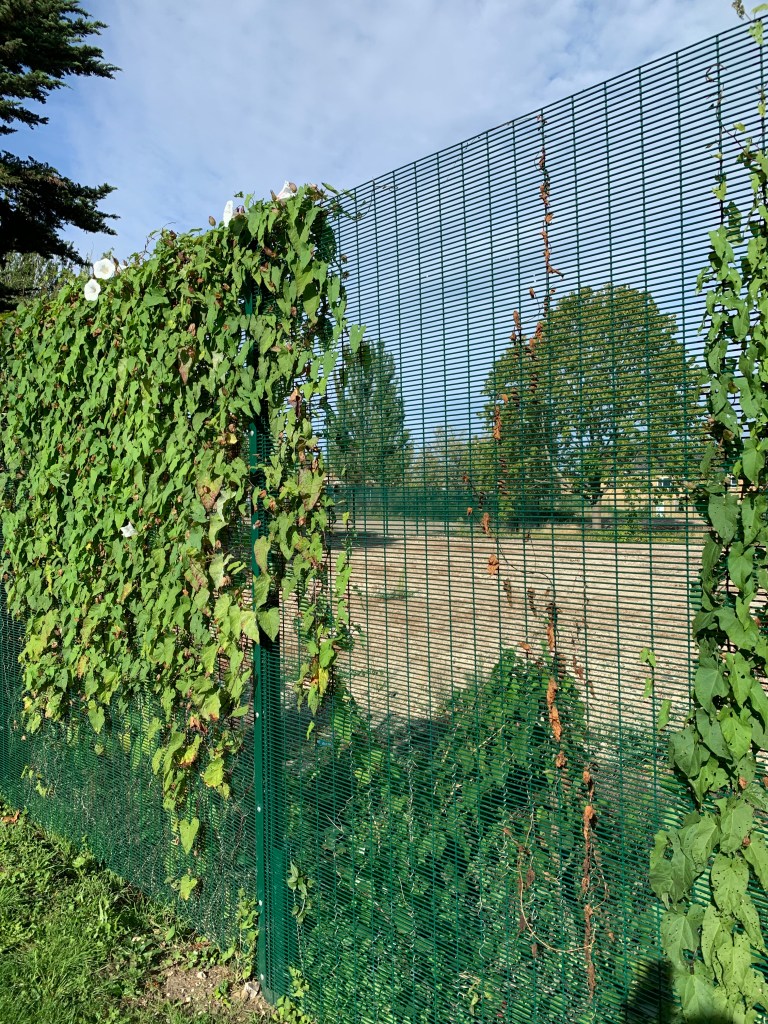
A garden run wild between the Innovation Gateway and one of the demolition sites

Thinking about all of this in direct relation to the questions I’ve outlined as my research project, it feels like the underlying question is one of whether the London Cancer Hub equates more closely to a wilderness or a garden. If it’s the former, the assumption would be that everything will grow together organically, creating its own ecosystem like a true, untampered-with, natural habitat, a wild area where species settle into their own relationships as they wander through the uncharted spaces. Or is it more like a garden? In that case, there would be dedicated horticulturalists planting, tending, pruning and nurturing amd mapping our the whole plot.

Given all the effort going in to the creation of the LCH and the high stakes of its success, my guess is that it needs to be a garden. And while there are definitely a lot of gardeners within individual areas, some of whom are also tending the boundaries, it would be interesting to understand the design for the whole landscape.

And finally – i need to think about why i am using landscape metaphors and not bodily ones!

‘Evolving the Ecosystem’

My residency at the London Cancer Hub will be spent working on a project I have called ‘Evolving the Ecosystem’. A central goal of the Institute of Cancer Research (ICR) strategy is to unravel the cancer ecosystem; cancers develop and grow very much as part of the environments of our bodies, and a priority for research at the ICR is to understand the mechanisms by which our individual or common internal bodily ecosystems govern whether cancers thrive or fail.

I was inspired by how the concepts we draw from ecology affect not only how a disease progresses, but potentially also how organisations thrive or fail in response to their environments. Below is an extract of the project proposal I put together to explain the research that I want to do whilst on this residency.

“Cancers have increasingly been seen as part of the complex ecology of the body rather than as diseases where rogue cells or tumours can be understood in isolation. Research scientists and clinicians are now focusing on investigating the characteristics and mechanisms of this ecology to find new ways to control or eliminate cancer. The conceptual framework of the ecology of cancer – and how to unravel it – has proved so useful that it now forms a central plank of the Institute of Cancer Research’s (ICR’s) current strategy.

Organisations too can be understood as ecologies. The London Cancer Hub (LCH) brings together a cross section of organisations working towards a synergistic set of goals, forming its own complex ecosystem, an ecosystem aiming to create an impact which is greater than the sum of its parts. How the constituent organisations – involving research scientists, businesses, clinicians, educators, carers and patients – collaborate across the new Hub to achieve this can similarly be viewed as an endeavour to develop a healthy ecosystem.

For this project I want to investigate these parallel ecologies side by side, drawing on frameworks and metaphors usually confined to the scientific context to explore what we can learn about the development of a culture and environment within which the potential for research, treatment and prevention can thrive.

The artwork emerging from the project would act both as an expression of the learning from the project and as a stimulus for further conversation going forward about how to build our capacity to tackle cancer. In addition, the stories gathered along the way would capture a moment in the history of cancer research and in the development of the LCH”.

I hope this conveys some of my ideas behind the project – which will surely also evolve as the project progresses. And if you have any thoughts about this that you’d like to discuss, do get in touch…..