A few weeks ago when I was over at the Royal Marsden I met up with the Arts Officer there, who is both creating an amazing arts programme for hospital patients and also curating and refreshing all the artwork that is displayed around the hospital. I’ll pop up another post with some images from our tour around the hospital at some point soon, but I wanted to record here the ideas we had about involving some of the clinicians who could give a perspective on the idea of the Ecosystem of the London Cancer Hub. The idea of running a workshop for Research Nurses emerged as they are central to the idea of ‘bench to bedside’, which is the intention to create a smooth transition to and from between research and clinical trials or treatments, an idea that feels to be at the heart of the idea of a London Cancer Hub ecosystem. You can find out more about Research Nurses here and about an example of ‘bench to bedside’ here.
After some drafting and conversation here’s the flyer that resulted. I hope it will be a fun experience for some research nurses as well as an opportunity to find out something of their perspective on the ecosystem. The flyer has gone out, and though as yet there are no bookings I am hopeful there’ll be some interest a bit nearer the time!
I was lucky enough recently to be able to spend a couple of hours steeped in the archive at Sutton Central Library, going through maps of the site where the London Cancer Hub is now based, and talking about the site with a member of the London Borough of Sutton team responsible for shepherding the London Cancer Hub site through the development process. Such a lot of interesting ideas emerged in one afternoon from talking about both the history and the future of the site. Once again I was overwhelmed with the amount that I learned and am full of questions about the implications for the evolution of the London Cancer Hub ecosystem as well as new ideas that may develop into artwork…
Site Plans
So, as I think i have probably already mentioned, the London Cancer Hub is made up of a number of different organisations or groups of organisation. The most significant of these that I have been thinking about are – in no particular order:
The Royal Marsden Hospital (mainly in purpose-built 1950s buildings but with a very new state-of-the-art structure)
The ICR (in brand spanking new purpose built blocks)
The Innovation Gateway (currently inhabiting a small existing mid-century block)
Maggie’s Cancer Centre (in one of their beautiful architecturally designed centres)
The element missing from that list is the major commercial site. The Innovation Gateway is the current incarnation of this, an incubator for small biotech, lifestyle and medical companies whose work fits well with the cancer focus of the Hub. But future plans are larger and more ambiutious, with a vision to house much larger companies (or parts thereof), big players in the medical and/or pharmaceutical world. There is a ‘preferred bidder’ to build this major development , with final contracts potentially being awarded in a few months time, depending on progress. The physical area for all the building to happen is currently essentially the demolition site of a number of old hospital buildings that were no longer useful and would have been complex and expensive, if not impossible, to adapt to this new purpose.
Downs / Sutton Hospital buildings scheduled for demolition
Discussion about this led quickly onto a conversation about land ownership. I had somehow assumed that there was a single site that formed ‘The London Cancer Hub’, owned by a single entity, but this is not the case. As i understand it post that conversation, the ICR owns its own plot; the NHS owns the plot on which the Royal Marsden stands, Maggie’s sits on the Royal Marsden site and the London Borough of Sutton has recently purchased the site for the commercial sector development, which as far as I can tell is referred to as The London Cancer Hub in itself also. This I think may be the root of some of the confusion that I’ve been feeling when talking to different people about the LCH – do we both mean the whole site encompassing everything, or do we mean the new commercial development? This adds to an existing confusion, for example, that I had during one conversation where the person i was talking to interpreted the London Cancer Hub as meaning the focus on the site during the pandemic for treating London-based cancer patients. I will be posting here again about some of this ambiguity, which feels quite important to the ongoing creation of a ‘London Cancer Hub’ ecology. However, ambiguity aside i found the way the sites come together to be fascinating, a real patchwork or mosaic of a site.
Site History
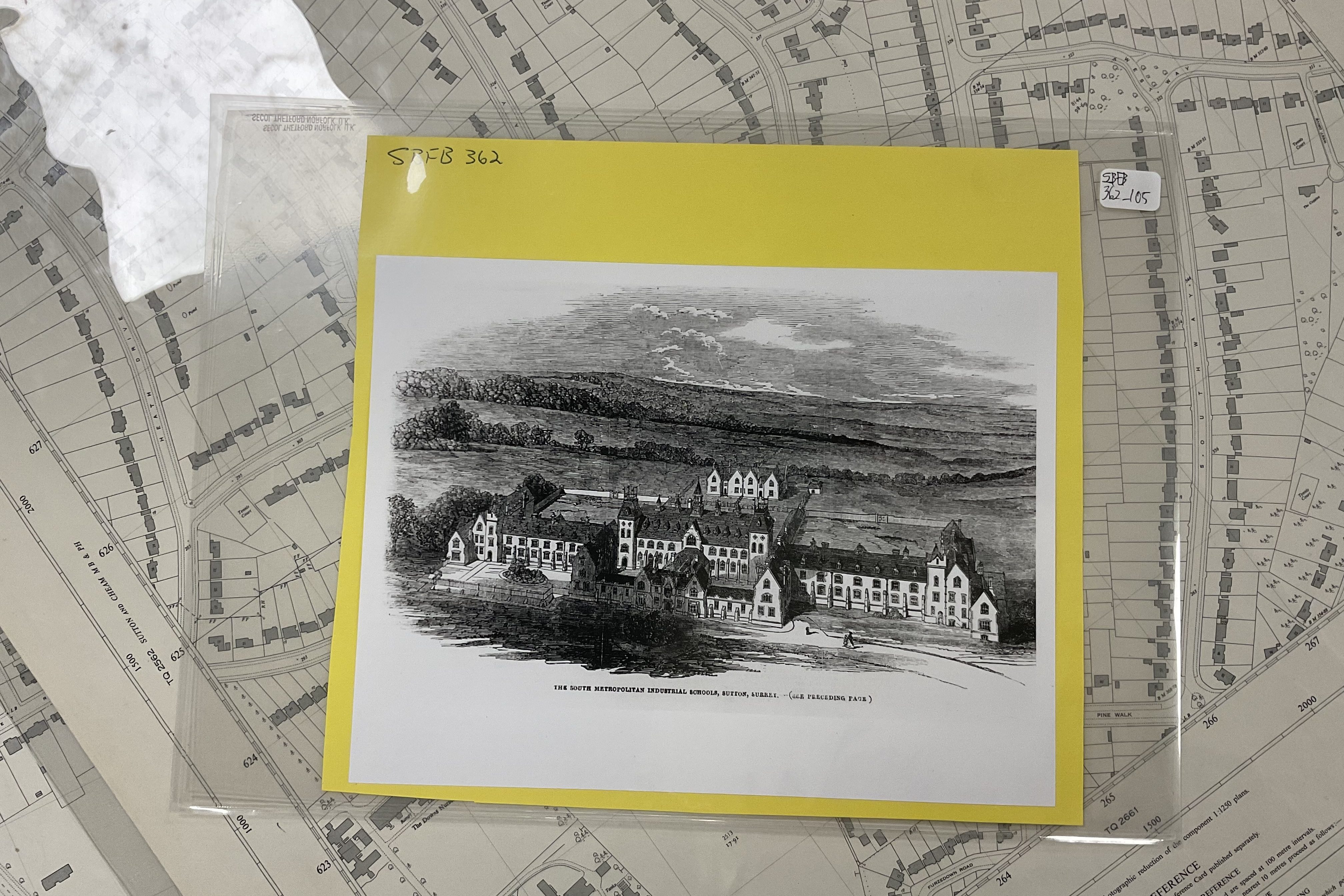
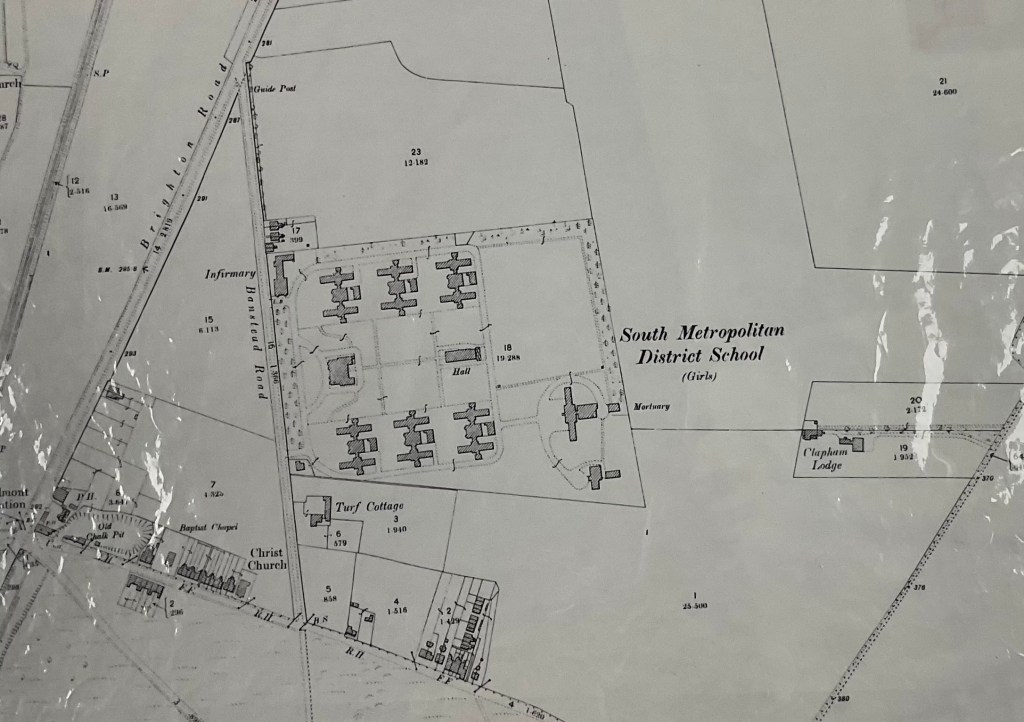
But before I get onto that, once back at the archive I had a chance to focus on the previous and historic uses of the site, which started as the South Metropolitan School for Girls in the mid 1800s.
The Site in 1896
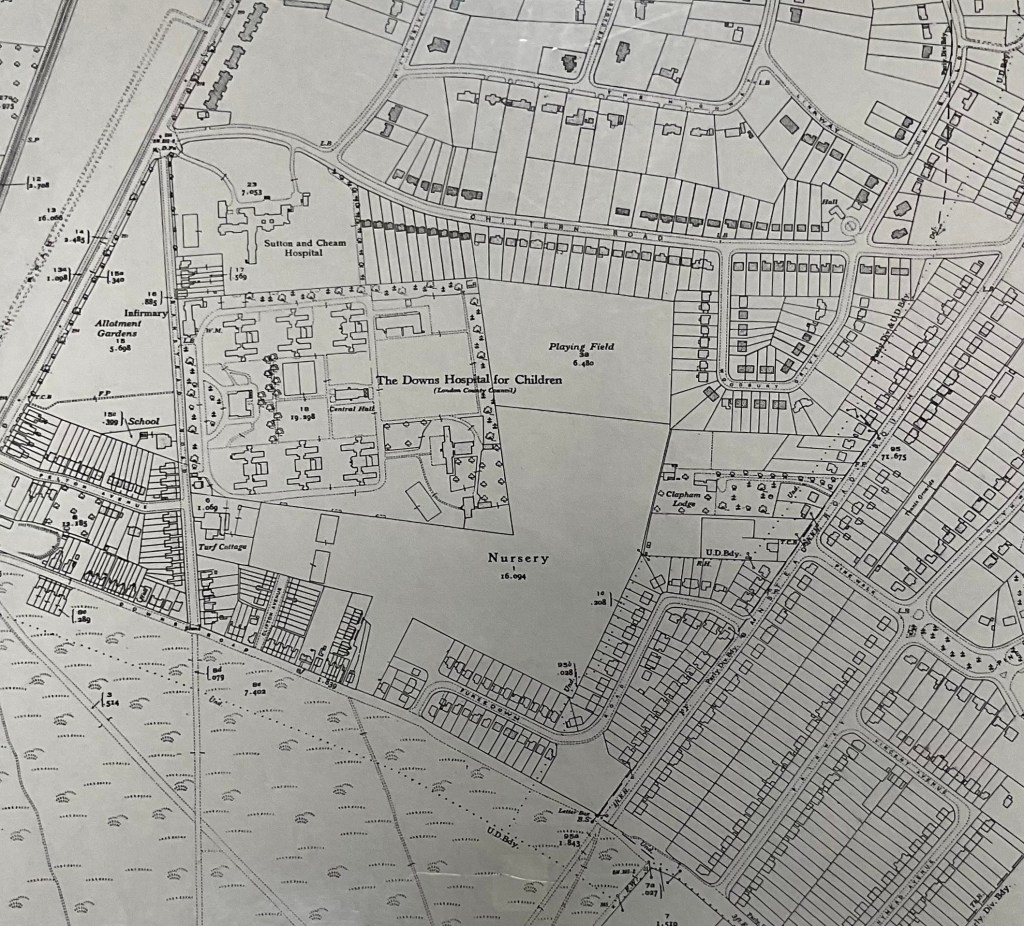
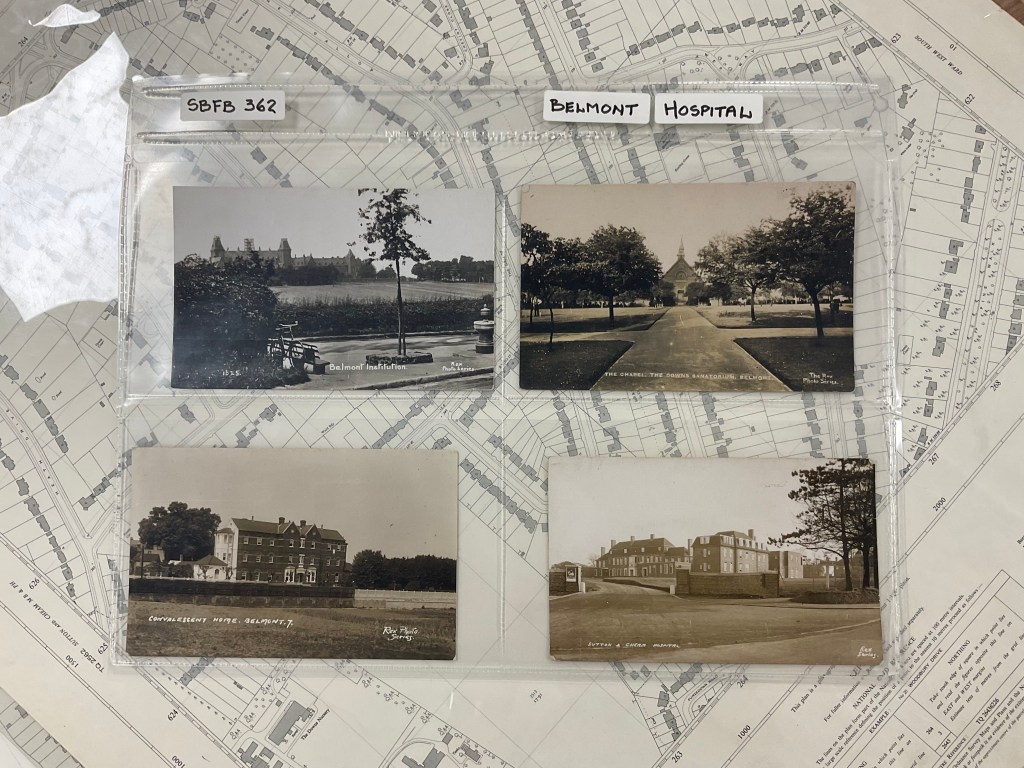
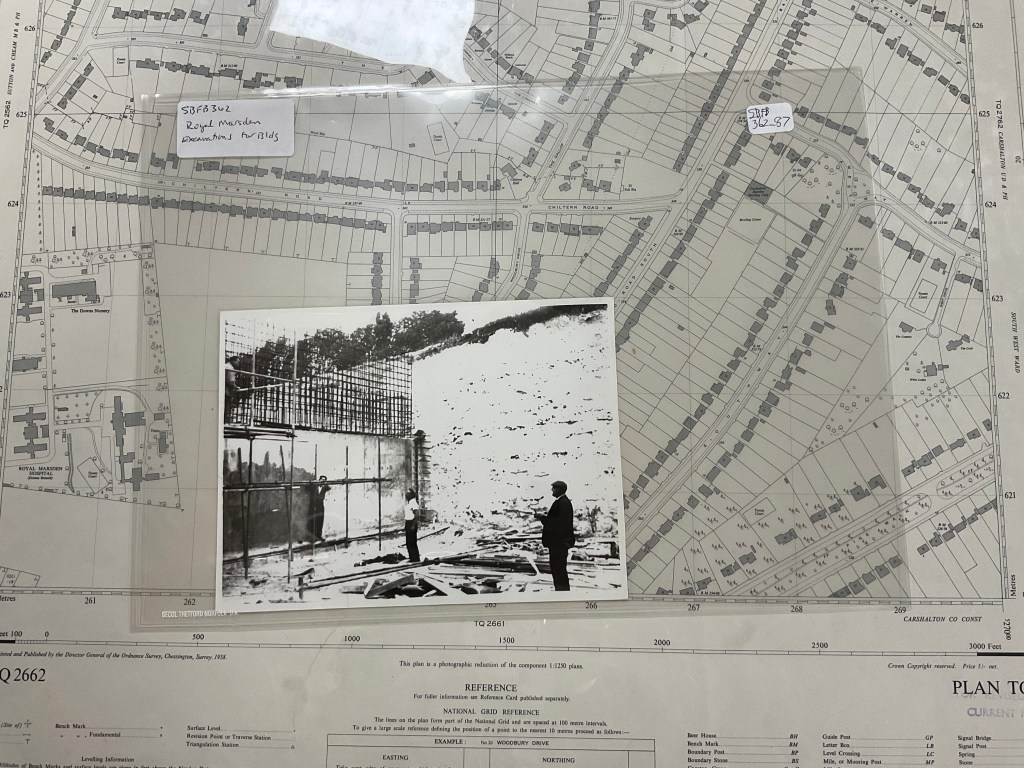
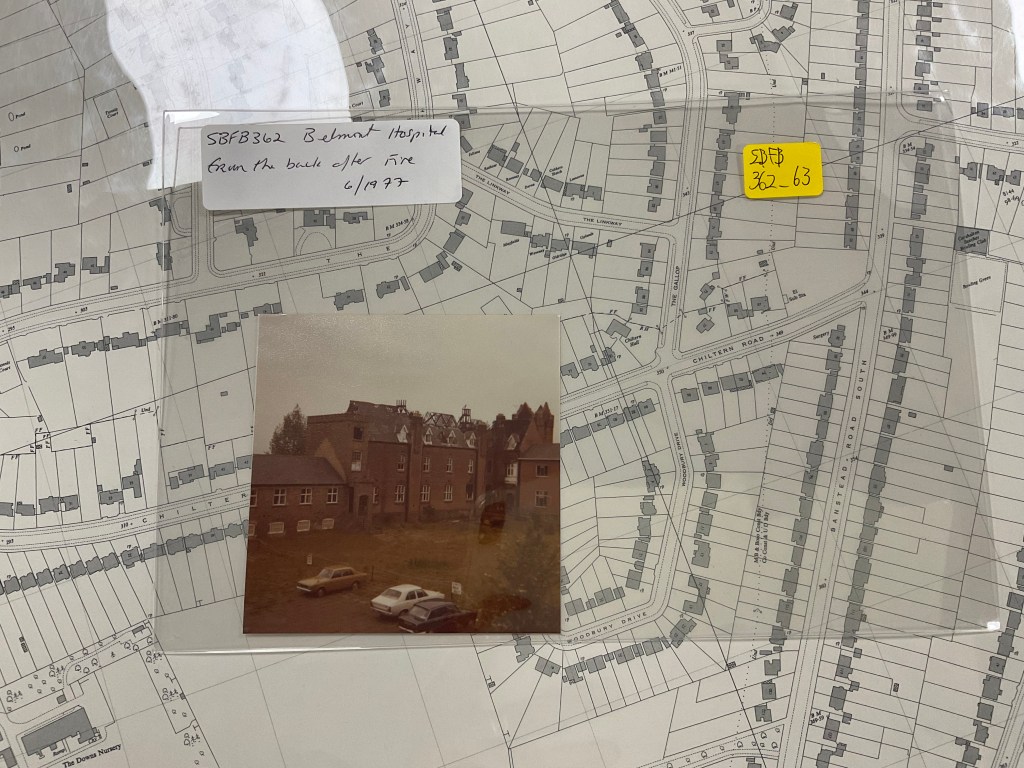
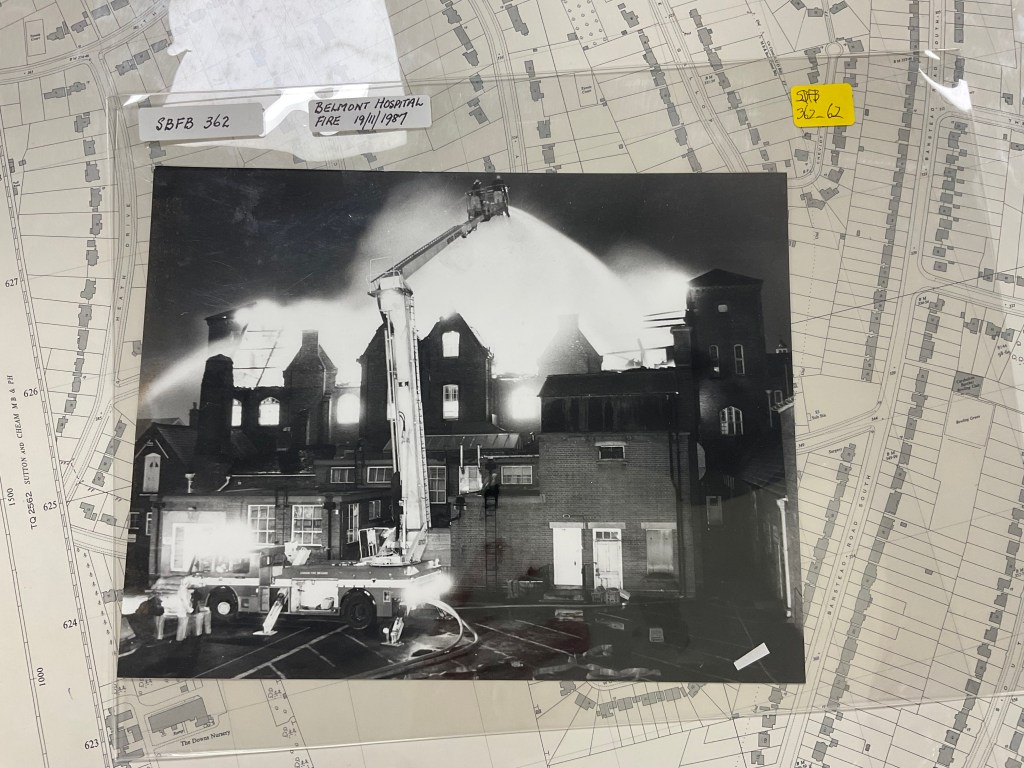
What follows is a series of images of the site over the years, thanks to the historic maps of the area, and some images of the buildings too from over the years. The building images are the ones that particularly struck me, though there were many more to choose from that might have given a more comprehensive overview of the way the buildings evolved and came together.
The Site in 1913The Site in 1935The original hospital buildings that were the Downs School, then the Belmont Hospital and then the Sutton Hosplital Digging the foundations for the Royal Marsden HospitalThe Downs Hospital in 2002
I was struck how this image is almost the same angle as the one above with the demolition barriers in place.
I also noticed as I pored through the images that there had been a lot of fires in the old hospital buildings.
After the Fire in 1956Ager the fire in 1977During the Fire in 1987
I’m not sure how the history of the buildings themselves or, indeed, the fires will feed into my understanding of the ecosystem, or they will feature in my artwork, but both struck me as interesting and worth recording here… The nature of the site as a mosaic of different ownerships, though, I already know is productive food for thought.
In the meantime, thanks so much to the LBS team and the archive for sharing the maps and letting me browse through the photos. Apologies that images are not great – they were my snapshots but maybe at some point I can go back and get better pictures….
While visiting St James Hospital, I spent some time in the Bexley Wing looking around where my artwork might be placed, both temporarily and on a more permanent basis.
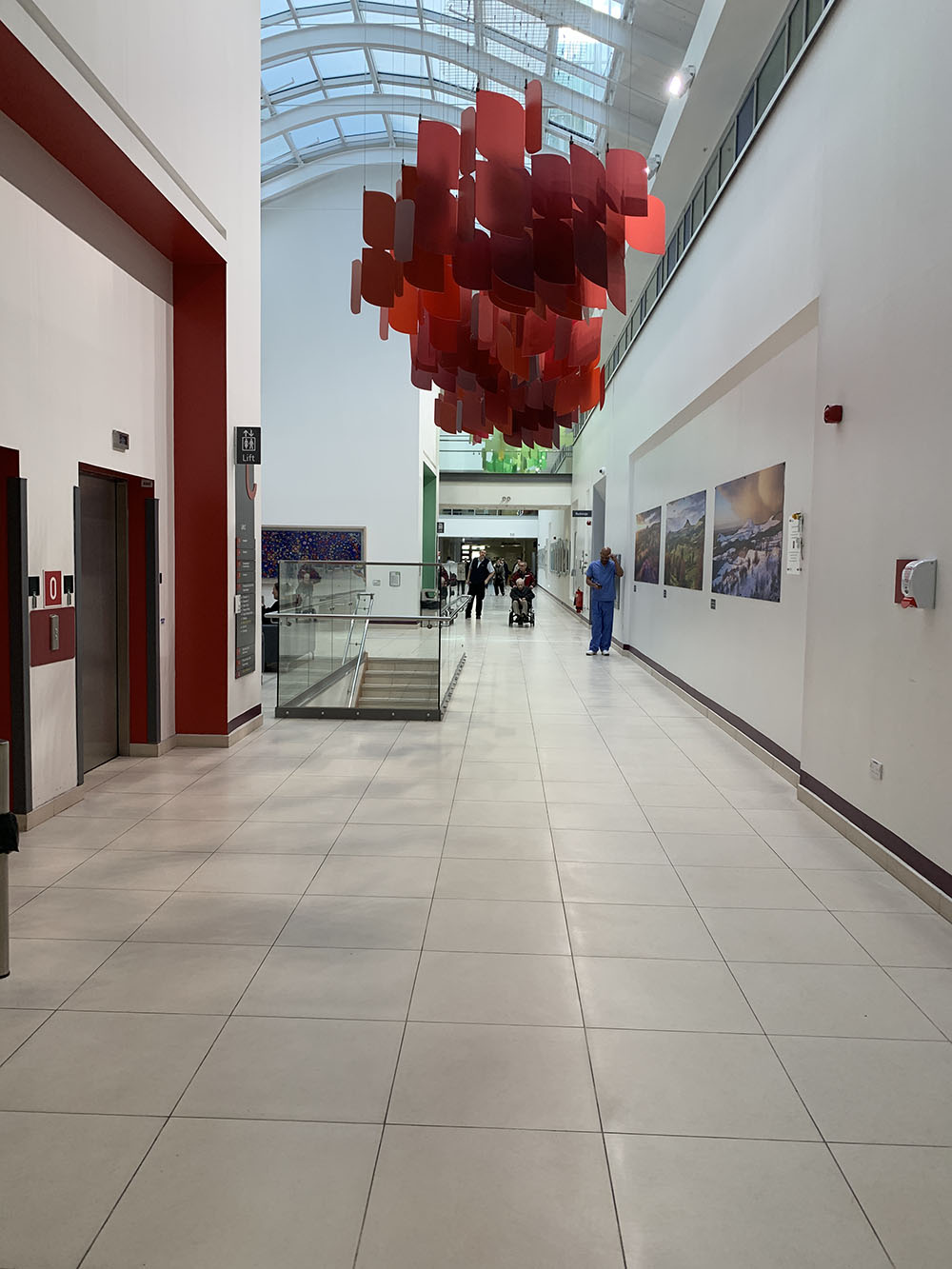
The idea, if all goes according to plan, would be for the artwork to spend its first three months once completed in the Atrium Gallery of the Bexley Wing. This is an amazing, huge, high-ceilinged and light-filled space which already has a considerable number of artworks on display at any one time.
About the Atrium Gallery
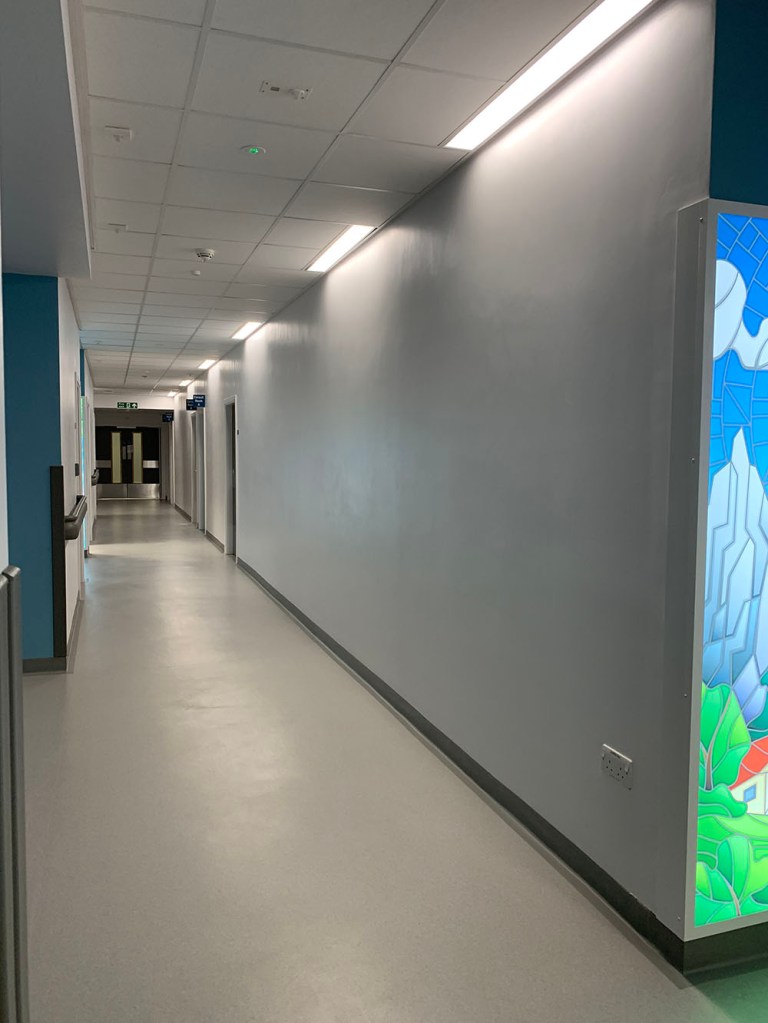
Following that it will move to the Clinical Research Facility (CRF) which had just opened for business when I was on my visit to the hospital, although without inpatients. Chris and Debbie showed me around the space and pointed out a couple of options for where my artwork might be placed, depending on which I preferred and what kind of artwork i would be making. We also looked at what else would be in the space, including the lightboxes (the edge of one of which you can see below) and some watercolours which had been commissioned for and donated to the CRF.
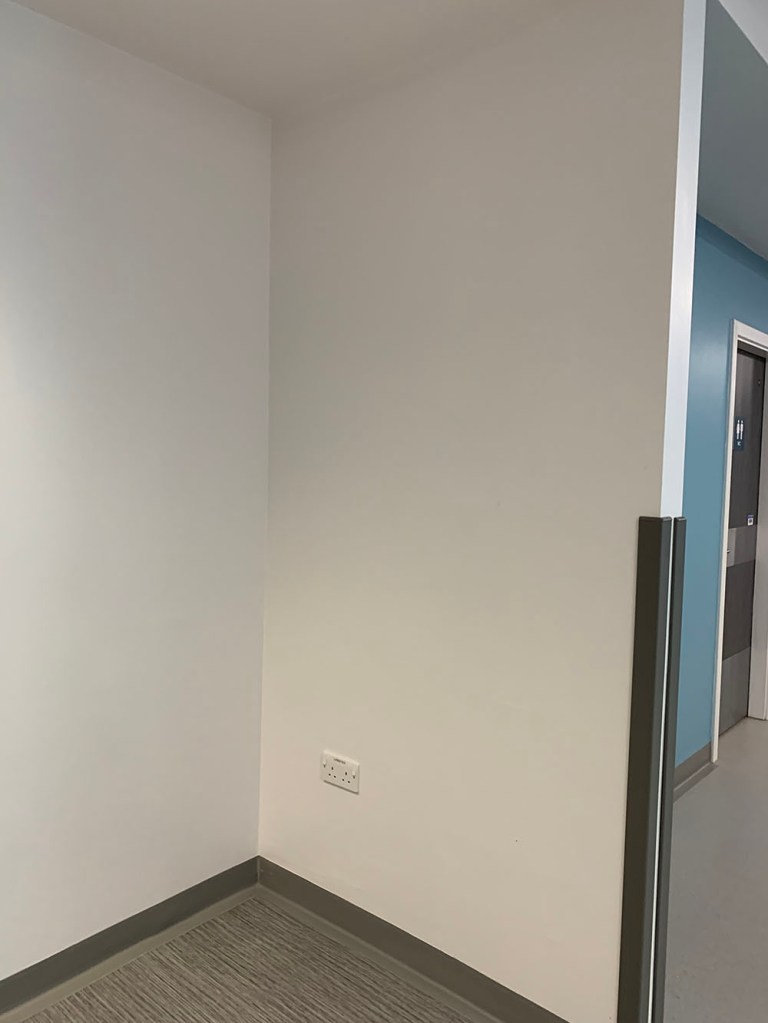
A long flat wall if I am making wall based workIf i want to make something plinth, table or floor based, this area of around 1m x 1m would be an option, also with handy power source
While we were looking at the space, Chris also shared that the CRF might be converted into a coronavirus treatment unit if required by the hospital for providing care during the pandemic.
This heightened our existing awareness that the artwork would need to be easy to clean, or possibly sterilise, as well as allowing the walls / floors near it to be cleaned effectively. For that reason Chris and Debbie were both very much in favour of having the artwork housed in some sort of a cabinet that would allow for external cleaning without disturbing the piece itself, and would enable the artwork to be moved to allow the areas around it to be cleaned.
I hadn’t really considered the artwork being encased in any way up until that conversation. We had talked about the requirement for the artwork to be safe for patients and staff, and I had been thinking about how to finish rough or sharp edges so that they would not present any difficulties, as well as how the piece could be kept clean. But most of my creative ideas had to that point been for an installation where the component parts were not contained, and so this represented quite a change in creative direction for me to contend with.
I mulled for a short time about whether I could happily create a work which would conform to the necessary cleaning requirements without being held in any form of container or cabinet, but quite quickly decided that this would be both limiting and complex, determining what kind of finishes and materials that I could use – probably mainly shiny and smooth surfaces, which does not fit well with my usual aesthetic or approach.
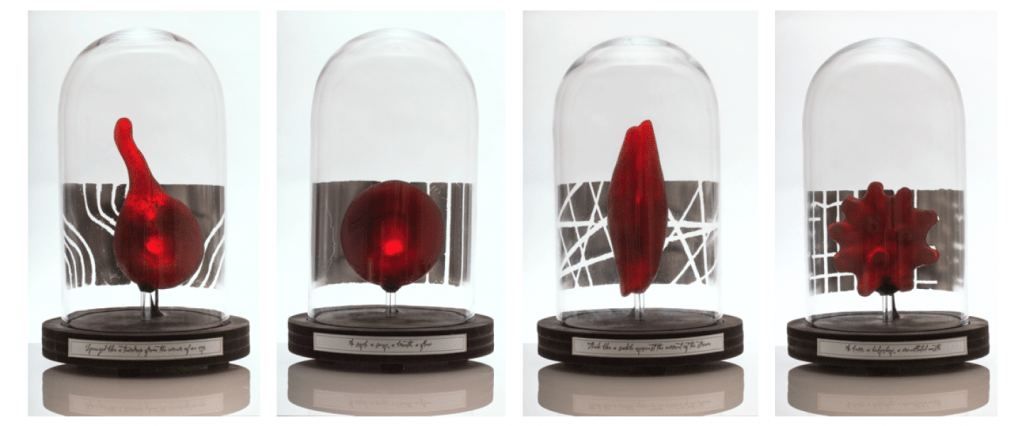
However, constraints can be very positive, and my first thought was to find a way to make the ‘cabinet’ part of the piece itself, which would be an interesting and challenging way forward. My mind immediately went to my ‘Blood Morphology’ pieces which have integral bell jars containing the blood cells.
My Blood Morphology Series with their integral glass domes
Bell jars or glass domes would definitely be a possibility for this artwork, but currently i am much more drawn to the idea of specimen cabinets or vitrines, especially as I don’t want to find myself repeating myself. I will be doing some research about the aesthetics of specimen cabinets and vitrines as well as looking into other artists who have used these, and will post about that separately…







 GLASS BODIES