Towards the end of the residency, one of the things I wanted to do was to share back with those who had contributed some of the process and outcomes of my time working at the London Cancer Hub. So we planned an event at the ICR to do just that.
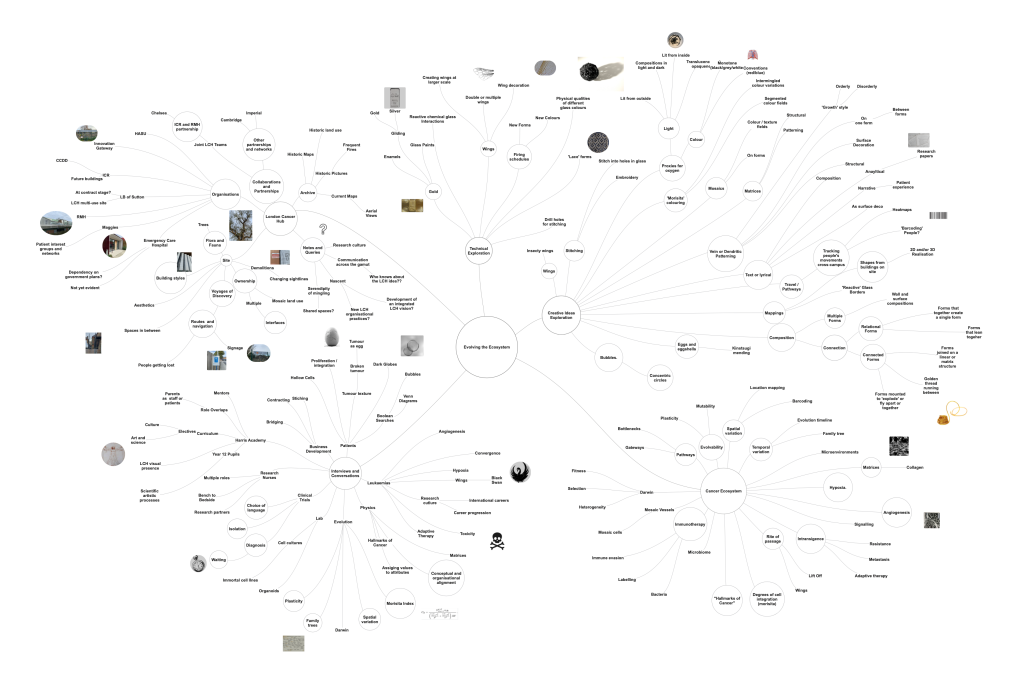
I was finding it really complex to work out how to convey all the thinking that I’ve been doing during the residency, and then my fabulous colleague, Siobhan Kneale, who has been working with me on behalf of Sutton Council and Sutton STEAMS ahead, suggested putting together a mind map.
I did, and it grew, and grew, and grew. Here it is in its semi-final form. It has proved an invaluable way to organise my ideas and to record my thinking. It doesn’t follow a single type of categorisation – the joy of a mindmap is that I can set creative ideas in the same context as noting ideas about the two ecologies and then branch into glass techniques and technical exploration. It is very much a personal record rather than any form of analytic, and highlights not everything I learned but those things that stuck out to me.
I also put together a map of metaphors according to how closely I found them to apply to the London Cancer Hub, the Cancer Ecosystem or both. Not a scientific process, more a finger in the air type of approach, but it will be useful to me nonetheless in capturing my thinking and shaping potential artwork.
I prepared prints of both of these for the Closing Event to share with participants and anyone else who might be interested…
When thinking about all the metaphors and how my artwork might develop I was immediately struck by the metaphor of cancer cells developing ‘wings’ as they transition from single tumours to metastatic disease. I knew it would be technically challenging making a piece in glass that reflected to any degree what I was visualising in my mind’s eye, but I thought I should try and at least capture something of the feeling by ‘going for it’ and seeing what I could achieve.
To understand the challenge, it’s necessary to share a little about how glass behaves when it’s heated. To make my pieces in ‘pate de verre’ (literally paste of glass), i make a paste from crushed glass or glass powder and apply it to a mould. This is the process you can track looking at my previous post about making ‘cells’. When the glass is then heated in a kiln, the powder or crushed glass fuses together in the heat to make a single surface. What holds it in position is a delicate balance between the level of heat and the structure of the mould. Too much heat and it will drop off the mould, too little and it won’t fuse and will return to dust.
When trying to create ‘wings’, if they are freestanding, they will sag in the heat and eventually drop onto the nearest surface, which might be the body of the cell or might be the shelf of the kiln. Luckily, earlier in the year I had learned a firing technique of firing pieces in a bowl of powder (sand or aluminium oxide) which could support the wings while the glass fused. For this i am grateful to the amazing glass artist Saman Kalantari. Here an image of some pieces I created by combining this firing technique with my own method of pate de verre.
However, what I wanted to achieve with this project was more ambitious technically in terms of the scale and form of the wings in relation to the ‘body’. My initial sketch for the piece is below.
As I’m not super comfortable in two dimensions I went on to make a 3D maquette out of polystyrene and wire mesh. You can follow the whole process through the flow chart below…
THe chart makes it look relatively straightforward, but I can reveal that it was not! Getting the firing right required multiple attempts, with the piece going into the kiln in one way or another about 5 times. Luckily, I wanted the piece to look a bit ‘distressed’ as this is entirely in keeping with the ideas of the cells that emerge with ‘with wings’ from the ‘cell graveyard’ within a tumour. The cell that emerged was a bit battered from all it had been through, but proved that it is possible to make a double-winged entity where the wings have a significant area in relation to the size of the ‘body’ of the piece.
Here is an image of the piece once I had brushed it off and done a bit of coldworking - that is, finishing edges and surfaces with grinding and polishing tools.
After making the ‘cell’ structured from ‘veins’ I tried a number of different approaches to applying vein-like patterns to the exterior of a cell structure. I wanted to try degrees of visual order or chaos, and to see how these effects looked in different tones – dark veins on pale background, pale veins on pale background, dark on dark etc. I also wanted to assess impact of variations in size. So i made a selection of other ‘dendritic’ cells to compare with the initial cell described in a previous post. Here are some images of the making process for these.
And here are some images of the finished cells
I also made a small sample of a potential flat panel featuring an image of a tangle of blood vessels with gilding added, representing something of a golden thread or pathway through the tangle. I went on to make three larger sample panels which became a series of three with the gilding ‘moving through’ the vein tangle and spreading across the panel.
Panels waiting to be fired for the first time before gilding
Working with different approaches to some of the same theme has felt very productive for me. I have got to assess creatively and technically which types of surface are most successful and most expressive. I also plan to gather some feedback from others as i begin to share the work to get a sense of what the different patterning and finishes convey to those who see them…
I have already written about my interest in angiogenesis as a process that forms part of the cancer ecosystem and that potentially functions as a metaphor in the LCH context (see Concepts and Metaphors (5)). It has been fascinating to look at images of the blood vessels that grow to support tumour growth. and equally interesting to see how clearly related the visual qualities of blood vessels from a tumour are to growth patterns observable around the LCH site, such as amongst the trees and ivy growing near the demokition site and close to the Royal Marsden.
On the left, an image of tumour blood vessels. Centre and right, images of trees and ivy on the LCH site.
These types of images were my starting point for making some glass samples and experimenting with using dendritic growth patterns as both structure for glass cells and for decoration.
And so, angiogenesis has emerged as a focus for my initial creative exploration. I have long been interested in creating vein-like, dendritic structures and decoration, so this is an evolution rather than complete change of direction for my own creative practice.
I decided to start with the basic form of the sphere, partly because i enjoy working with that form, and partly because to me the sphere is suggestive of the shape of a cell (regardless of the fact that not all cells are spherical).
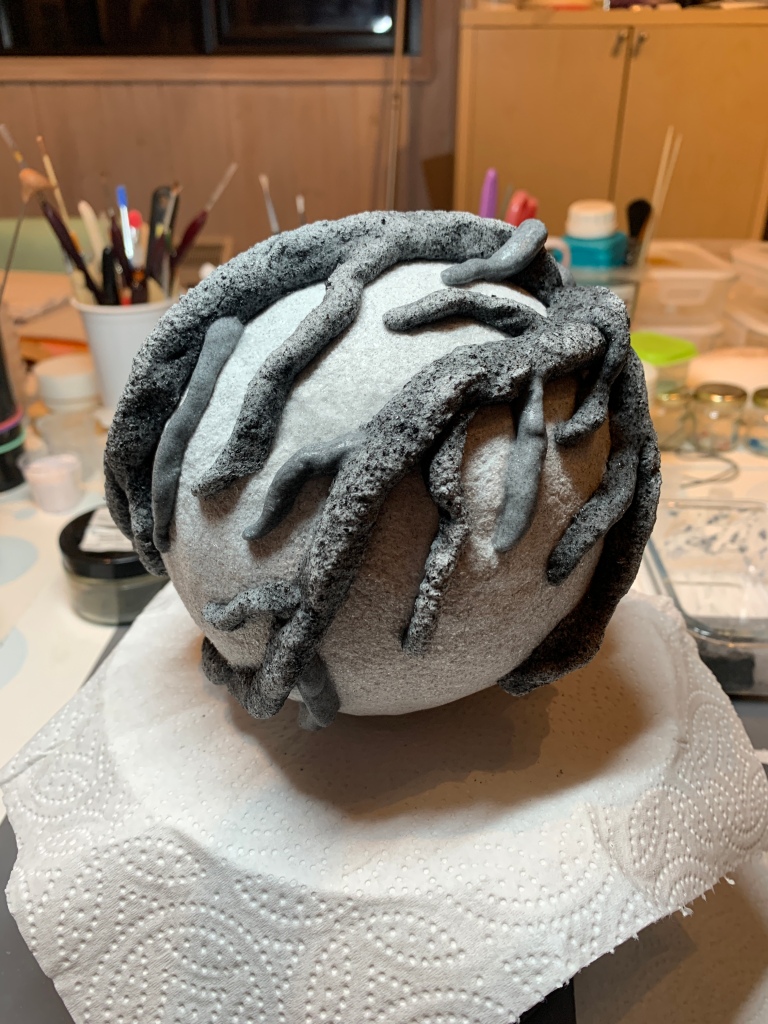
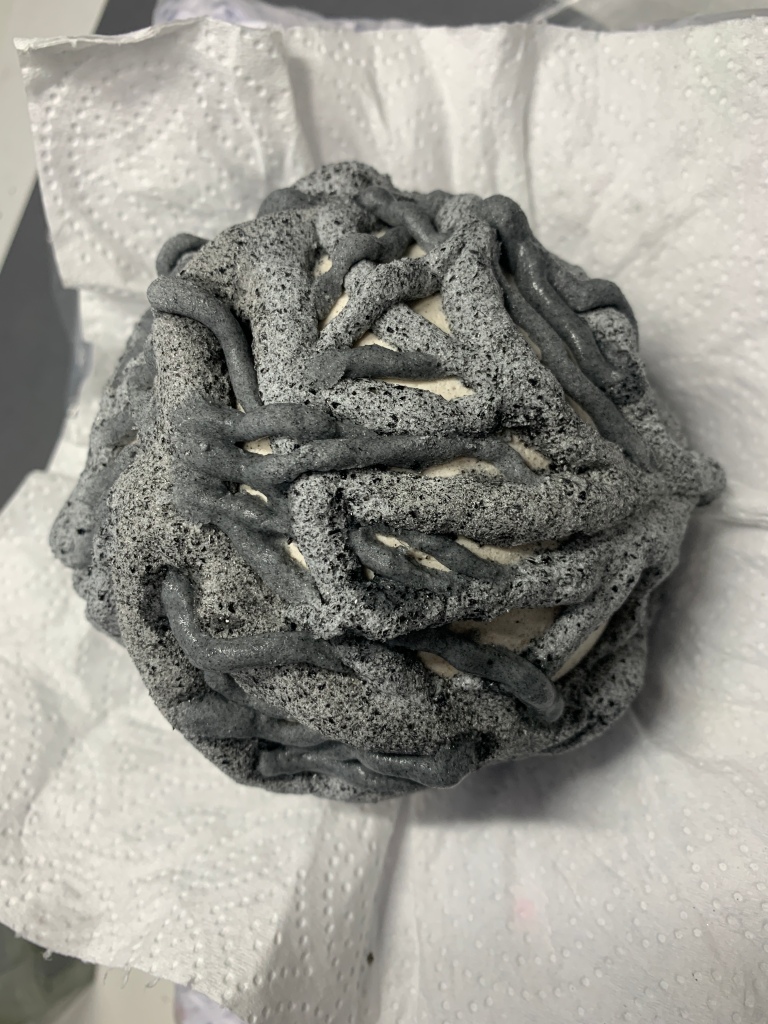
My first idea was to try and construct the form as a whole just from ‘veins’ to see if i could form the cell structure that way. The following images track my progress along that path.
The first line of images above shows the initial ‘veins’ of glass paste that build the structure of the glass over the mould. The second line of images shows a later stage where more veins have been added and interwoven. I was aiming at an outcome that was somewhat evocative of the growth patterns in the images of the tumour blood vessels and also the tree and ivy growth.
In the kiln before firing
This is how the piece looked when it went into the kiln for firing. Glass paste shrinks considerably when it’s fired, so I was expecting the veins to be more slender when they emerged. From the technical perspective I was concerned about whether the structure would be strong enough and stable when it emerged as the shrinkage can also cause the glass to pull away and disconnect or to crack and break. From a creative perspective I wanted to see how the veins looked after firing to see if they (still) evoked the tumour and growth patterns.
Post firing with the mould still insideAfter removing the mould
This is how the finished ‘cell’ looks below with a bit of directional lighting. Luckily the firing went well and the piece emerged intact. As a sample or prototype I am very happy with how it’s turned out. It was very time consuming to make – more so than the samples of dendritic cells that i made subsequently, as the lack of underlying structure for the veins made the whole thing more complex. I also felt that the shrinkage of the glass made the piece slightly less evocative than it was pre-firing, but to some extent this could be changed in subsequent pieces.
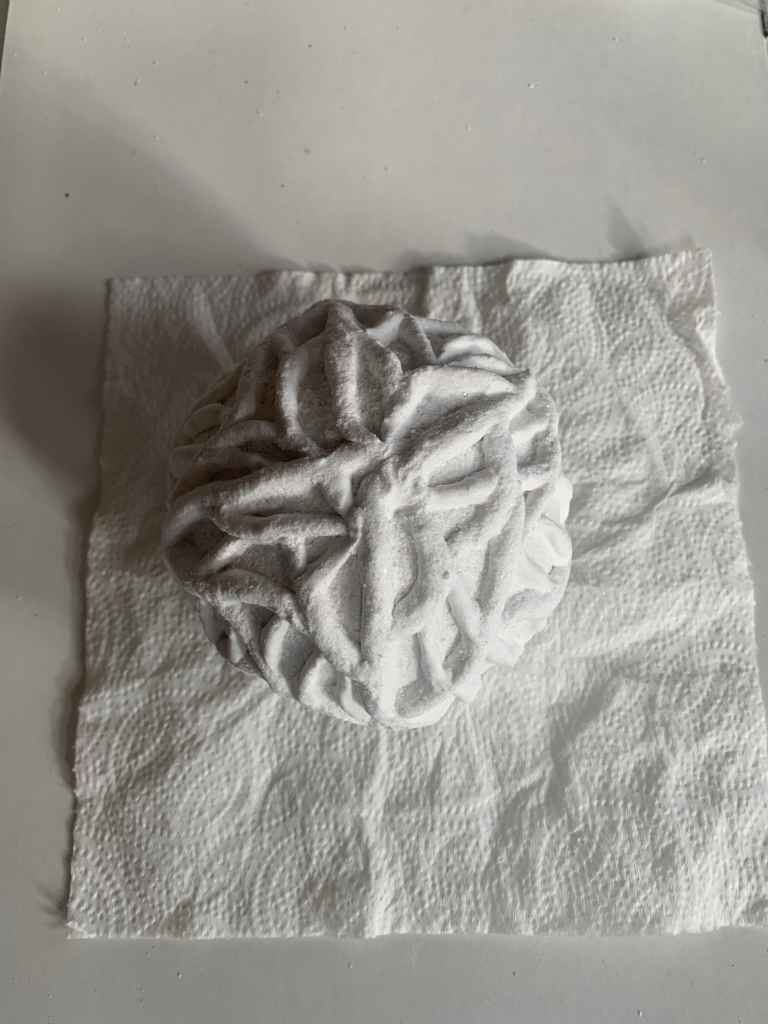
One thing I should add at this point is that this – as a sample or prototype – is not intended to be a standalone piece. My intention was that it could be a model for a component of a composition of cells, potentially some in light, some in shadow. I knew also that I wanted to experiment with working in a pale colour, probably white, and making vein structures that were also more ordered, less chatotic. So that’s what I did next.
Over the years I have become particularly interested in how we visualise cancer in our own bodies. When i found a lump in my neck in my late twenties, I had a visual image of what was going on that probably had nothing to do with the science of the thyroid and everything to do with how i was feeling and how my mind’s eye works. Initially I received the diagnosis that the lump on my thyroid was benign – at which point I stopped thinking about it so much. A revision of the pathology results and a reclassification of the diagnosis to a malignancy focused my attention very much back on what was happening in my body. I can still recall much of how I visualised the progression from feeling the lump in the first place though the initial diagnosis and then during further treatment.
Since i started to pursue art as a career I have followed this interest in how we imagine what’s taking place in our bodies when we are well and when we are not. I absolutely don’t expect that everyone’s visualisation style will match mine and I also don’t imagine that other people’s visualisation of what’s happening inside them will necessarily match to the science of their condition any more than mine did – though it might. For me there was much too much emotion influencing what I ‘saw’. Nonetheless – or more probably because of that – I am intrigued about the imagery that populates our minds when something changes in our bodies or we’re told that something has gone wrong.
Last year I was lucky enough to work on a project that allowed me to partner with an individual to explore with them their experiences of cancer and chemotherapy and how it played out in their own mind’s eye. The result was several pieces of artwork that reflected their sense of how cancer and chemotherapy worked its way through their body. For this project I wanted to continue to involve people dealing with cancer themselves, finding a way to connect with people who are interested in the project; patients are, after all, the reason that the London Cancer Hub exists at all. Thanks to the support of the Patient and Public Involvement and Engagement Team at the Royal Marsden, and their platform, the Cancer Patient’s Voice (see previous posts) I was able to get in contact with some patients who had expressed an interest in taking part.
In the mind’s eye…
As a result I was lucky enough to speak with several patients who were undergoing active treatment or who were under ongoing observation. I had fascinating and wide-ranging conversations with all of them about their treatment, their experiences of the LCH and about how they visualised their disease, both in terms of their personal experiences and in relation to the science they had learned as part of their treatment. Rather than going into detail about each of the conversations, in my next post on this theme I am going to consolidate some of the outcomes of our conversations.
Each of the people who talked with me were generous enough to give me permission – despite the very personal nature of their stories – to use their observations and experiences as inspiration for artwork and potentially within the artwork itself. I am enormously grateful to all of them for their generosity and help.









 GLASS BODIES