
As the project evolves(!) it feels like time to reflect on some of the things I’ve learned about the LCH as an entity as well as continuing to update this blog with all the concepts and metaphors I’ve drawn from the conversations about cancer research.
And now that I’ve talked to a variety of folk based at the Sutton site from the ICR, the Royal Marsden and also from the London Borough of Sutton I am both a whole lot clearer and a whole lot less clear on what the London Cancer Hub actually is.
Fundamentally, it seems to me that the ‘London Cancer Hub’ is an idea. It’s not the only example of a ‘hub’ that brings together similar types of organisation in one site with the aim of maximising the potential of the co-sited organisations by placing them together. See for example, this article by UK Research and Innovation outlining collaborations across the UK, several of which include co-location, or this one about the Imperial College White City Life Sciences campus. What makes the London Cancer Hub unique is its tight focus on the science of the prevention and treatment of cancer.
But beyond that simple explanation of a shared goal, I have been struggling a little with what actually binds the London Cancer Hub together, and what differentiates it from other partnerships and collaborations that are aimed at cancer treatment and care. And when I started to delve, I realised that I had arrived with a whole set of assumptions, many of which I am only now becoming aware. And because I am dealing with snapshots, transient impressions and fragments of explanation, which are the nature of the types of conversation I have been having, it’s going to be a little tricky to pin down what I mean, but here’s an attempt.
When I heard about the London Cancer Hub, I assumed that there was some sort of integration effort that was bringing all the disparate elements of the London Cancer Hub into some sort of intertwined relationship. By that I don’t mean at all that I thought there was going to be a single overseeing organisation or that the different parts would become a single body, but I did think there was probably a sort of masterplan that was dedicated to ensuring the different organisations would begin to intermingle more, and to encourage cooperation and cross-fertilisation of ideas and activities.
And now I am not so sure this is the case. (And as ever, i may be mistaken, but if so, that in itself may be indicative of something). Whilst there is clearly significant collaboration going on – in particular I know there are lots of positive and proactive interconnections between the ICR and the Innovation Gateway, and the ICR and the Royal Marsden have a longstanding relationship – I am more unclear about how the LCH as a whole will be becoming actively more than the sum of its parts? And how it will be significantly different or more than the existing partnerships. Here are some questions (in no particular order) that have arisen for me so far from that point of view:
- How will people know that this is now – or becoming? – the London Cancer Hub? Several of my interviewees so far have not appeared to know what I meant by ‘London Cancer Hub’ without an explanation from me. Is that timing? Does it matter? How does that change if it does matter?
- Who – if anyone – takes the overview of the experience of a member of the public visiting the site, wandering around, and crossing boundaries, visiting different organisations? Does the idea of a visitor experience that crosses between areas matter? Will there be a single map? And/or am I in such a unique position that its unlikely to matter to anyone else?
- How is the aesthetic experience of the site managed as a whole? Maybe that’s not important, given that there is always going to be a mish-mash of interesting buildings from different eras, but maybe there are things that might bring a useful coherence? Or maybe different identities as you traverse the site is grounding?
- How about the staff experience of being part of a London Cancer Hub? Will there be ways to encourage curiosity or collaboration between the people in different organisations beyond what is structurally necessary?
- How will the serendipitous discovery of overlapping interests happen as a result of the Hub’s existence? Who provides space for people from different organisations to intermingle randomly and interestingly – or who will in the future? So far the only place on the site that seems to specifically cater for staff from across the site is the small social club with a once-a-week bar. Is anyone responsible for creating these sorts of spaces? Or is that not how things work? Or maybe just not yet…
More than one of the people I have spoken to so far has looked at me blankly when I’ve asked about what makes the Hub a Hub beyond all being in the same place. I am fully aware that it’s very early days for the London Cancer Hub and maybe it’s too early for these sorts of questions. And maybe ultimately it doesn’t matter. But maybe it does? It would certainly matter if the bonding and binding has an impact on the research, treatment and care of patients and the inspiration, motivation and satisfaction of staff?

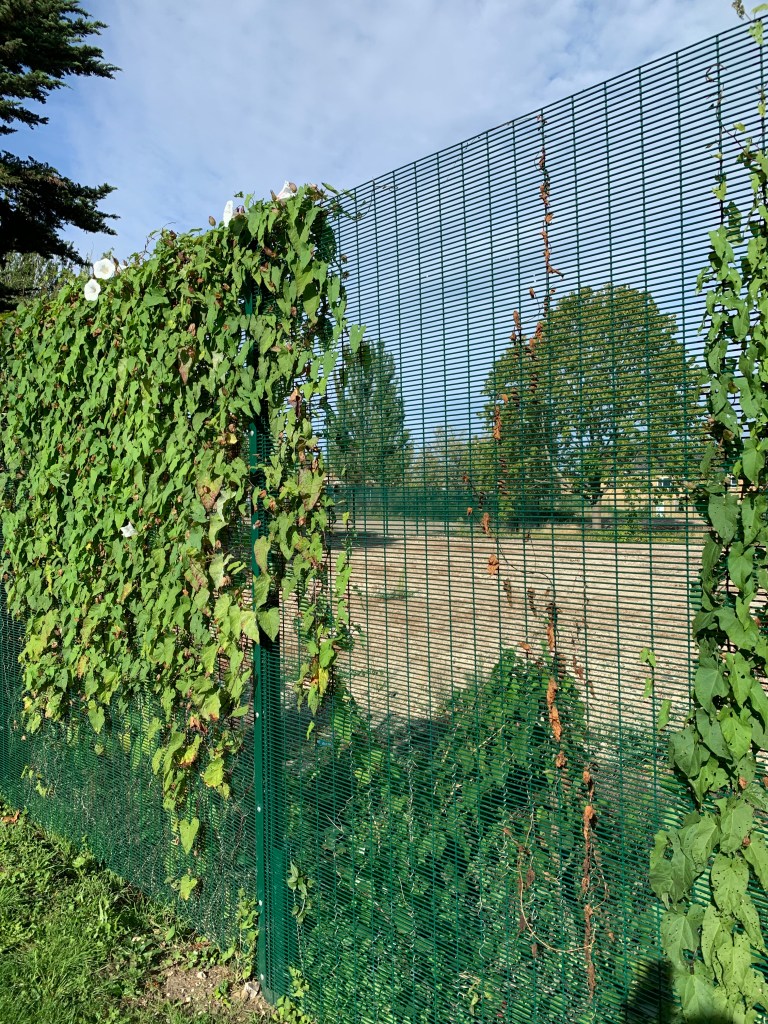
Thinking about all of this in direct relation to the questions I’ve outlined as my research project, it feels like the underlying question is one of whether the London Cancer Hub equates more closely to a wilderness or a garden. If it’s the former, the assumption would be that everything will grow together organically, creating its own ecosystem like a true, untampered-with, natural habitat, a wild area where species settle into their own relationships as they wander through the uncharted spaces. Or is it more like a garden? In that case, there would be dedicated horticulturalists planting, tending, pruning and nurturing amd mapping our the whole plot.
Given all the effort going in to the creation of the LCH and the high stakes of its success, my guess is that it needs to be a garden. And while there are definitely a lot of gardeners within individual areas, some of whom are also tending the boundaries, it would be interesting to understand the design for the whole landscape.
And finally – i need to think about why i am using landscape metaphors and not bodily ones!
 GLASS BODIES