Today’s concepts and metaphors are mainly related to cancer’s evolutionary abilities. These ideas relate directly or indirectly to the ways in which cancer can mutate, grow and evade treatment and the ways that these are talked of. This particular selection of ideas is currently not at the heart of my artwork development, but I feel it is important to note them nonetheless.
“Wild Type“
The wild type (WT) is the phenotype that is the typical form of a species as it occurs in nature
“Convergence“
Where nature comes up with the same solution time and time again though through different paths, eg human and octopus eyes, bat and bird wings.
“Plasticity“
Cell plasticity is the ability of cells to change their phenotypes – without genetic mutations – in response to environmental cues. This is one of the ways that cancers can become resistant or intransigent. The other main way is through genetic mutation.
“Resistance“
Cancers that evolve to be able to survive specific drugs. This may happen either though the plasticity of that particular cell type or through the processes of selection.
“Intransigence“
Cancers that resist treatment or are unlikely or impossible to be successfully treated.
“Evolvability“
How likely a cancer is to be able to evolve into different manifestations through plasticity or selection. This concept arrived with me through reading this article, co-authored by many ICR researchers (some of whom I have spoken with) rather than via interviews
“Adaptive Therapy“
Using a range of treatment options to manage the cancer as a chronic condition to maximise quality of life and longevity rather than trying to blitz the cancer with the strongest treatments and risking it becoming more and more resistant and intransigent.
How all this relates to the London Cancer Hub
The LCH is undoubtedly at an early stage of its evolution as a single entity, so I would expect some of these notions to apply, albeit maybe not in the specific ways that they apply to disease. And if I think about my experiences of organisation development I can certainly draw parallels.
Intransigence, for example, is something that I definitely came across at the BBC – or at least it felt that way to me. It seemed that any number of people could make any amount of effort to change things – to reduce staff numbers, say – and yet the organisation would seem to go its own sweet way and somehow, despite reductions and redundancies, there always seemed to be the same number of people working there from year to year and onwards.
Plasticity too has a resonance in this respect – for me it equates to how far an organisation can adapt its ways of working without fundamentally changing its structure or identity (something that might feel more like a mutation).
However, these specific concepts have not captured my creative imagination for some reason in themselves as a basis for artwork, though they are definitely informing my thinking. My next post in this series will, on the other hand, focus on some of the concepts that i have started to investigate creatively.
A few weeks ago when I was over at the Royal Marsden I met up with the Arts Officer there, who is both creating an amazing arts programme for hospital patients and also curating and refreshing all the artwork that is displayed around the hospital. I’ll pop up another post with some images from our tour around the hospital at some point soon, but I wanted to record here the ideas we had about involving some of the clinicians who could give a perspective on the idea of the Ecosystem of the London Cancer Hub. The idea of running a workshop for Research Nurses emerged as they are central to the idea of ‘bench to bedside’, which is the intention to create a smooth transition to and from between research and clinical trials or treatments, an idea that feels to be at the heart of the idea of a London Cancer Hub ecosystem. You can find out more about Research Nurses here and about an example of ‘bench to bedside’ here.
After some drafting and conversation here’s the flyer that resulted. I hope it will be a fun experience for some research nurses as well as an opportunity to find out something of their perspective on the ecosystem. The flyer has gone out, and though as yet there are no bookings I am hopeful there’ll be some interest a bit nearer the time!
As the project evolves(!) it feels like time to reflect on some of the things I’ve learned about the LCH as an entity as well as continuing to update this blog with all the concepts and metaphors I’ve drawn from the conversations about cancer research.
And now that I’ve talked to a variety of folk based at the Sutton site from the ICR, the Royal Marsden and also from the London Borough of Sutton I am both a whole lot clearer and a whole lot less clear on what the London Cancer Hub actually is.
A view across the LCH from the ICR access road to the new Innovation Gateway site
Fundamentally, it seems to me that the ‘London Cancer Hub’ is an idea. It’s not the only example of a ‘hub’ that brings together similar types of organisation in one site with the aim of maximising the potential of the co-sited organisations by placing them together. See for example, this article by UK Research and Innovation outlining collaborations across the UK, several of which include co-location, or this one about the Imperial College White City Life Sciences campus. What makes the London Cancer Hub unique is its tight focus on the science of the prevention and treatment of cancer.
But beyond that simple explanation of a shared goal, I have been struggling a little with what actually binds the London Cancer Hub together, and what differentiates it from other partnerships and collaborations that are aimed at cancer treatment and care. And when I started to delve, I realised that I had arrived with a whole set of assumptions, many of which I am only now becoming aware. And because I am dealing with snapshots, transient impressions and fragments of explanation, which are the nature of the types of conversation I have been having, it’s going to be a little tricky to pin down what I mean, but here’s an attempt.
When I heard about the London Cancer Hub, I assumed that there was some sort of integration effort that was bringing all the disparate elements of the London Cancer Hub into some sort of intertwined relationship. By that I don’t mean at all that I thought there was going to be a single overseeing organisation or that the different parts would become a single body, but I did think there was probably a sort of masterplan that was dedicated to ensuring the different organisations would begin to intermingle more, and to encourage cooperation and cross-fertilisation of ideas and activities.
And now I am not so sure this is the case. (And as ever, i may be mistaken, but if so, that in itself may be indicative of something). Whilst there is clearly significant collaboration going on – in particular I know there are lots of positive and proactive interconnections between the ICR and the Innovation Gateway, and the ICR and the Royal Marsden have a longstanding relationship – I am more unclear about how the LCH as a whole will be becoming actively more than the sum of its parts? And how it will be significantly different or more than the existing partnerships. Here are some questions (in no particular order) that have arisen for me so far from that point of view:
How will people know that this is now – or becoming? – the London Cancer Hub? Several of my interviewees so far have not appeared to know what I meant by ‘London Cancer Hub’ without an explanation from me. Is that timing? Does it matter? How does that change if it does matter?
Who – if anyone – takes the overview of the experience of a member of the public visiting the site, wandering around, and crossing boundaries, visiting different organisations? Does the idea of a visitor experience that crosses between areas matter? Will there be a single map? And/or am I in such a unique position that its unlikely to matter to anyone else?
How is the aesthetic experience of the site managed as a whole? Maybe that’s not important, given that there is always going to be a mish-mash of interesting buildings from different eras, but maybe there are things that might bring a useful coherence? Or maybe different identities as you traverse the site is grounding?
How about the staff experience of being part of a London Cancer Hub? Will there be ways to encourage curiosity or collaboration between the people in different organisations beyond what is structurally necessary?
How will the serendipitous discovery of overlapping interests happen as a result of the Hub’s existence? Who provides space for people from different organisations to intermingle randomly and interestingly – or who will in the future? So far the only place on the site that seems to specifically cater for staff from across the site is the small social club with a once-a-week bar. Is anyone responsible for creating these sorts of spaces? Or is that not how things work? Or maybe just not yet…
More than one of the people I have spoken to so far has looked at me blankly when I’ve asked about what makes the Hub a Hub beyond all being in the same place. I am fully aware that it’s very early days for the London Cancer Hub and maybe it’s too early for these sorts of questions. And maybe ultimately it doesn’t matter. But maybe it does? It would certainly matter if the bonding and binding has an impact on the research, treatment and care of patients and the inspiration, motivation and satisfaction of staff?
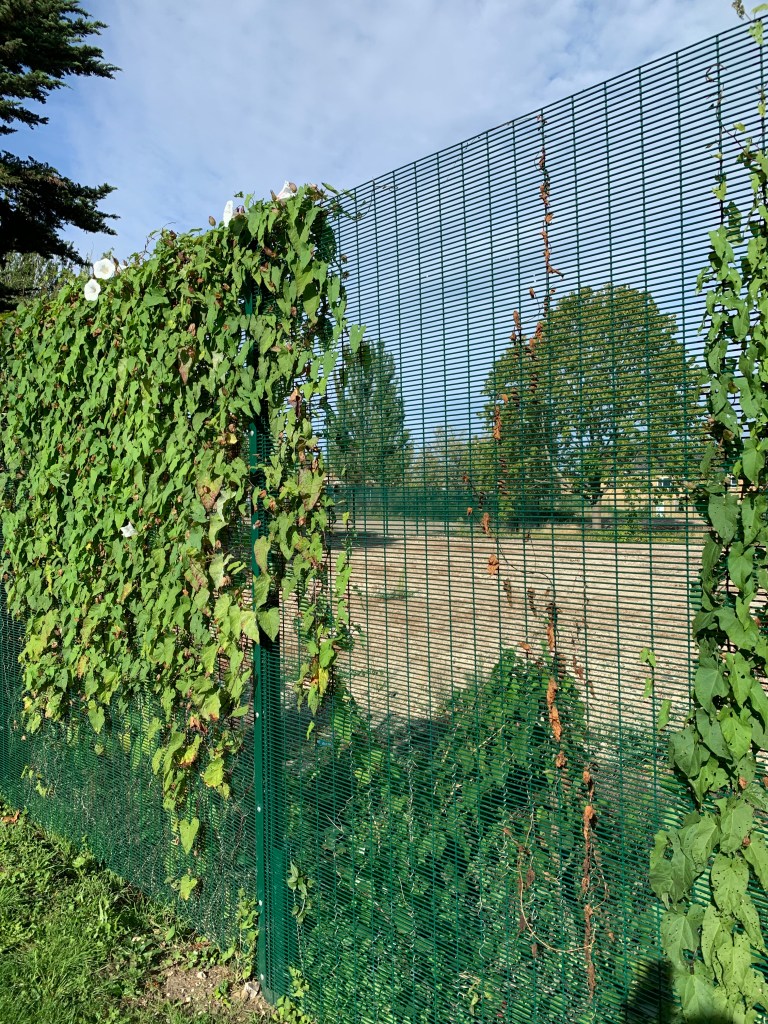
A garden run wild between the Innovation Gateway and one of the demolition sites
Thinking about all of this in direct relation to the questions I’ve outlined as my research project, it feels like the underlying question is one of whether the London Cancer Hub equates more closely to a wilderness or a garden. If it’s the former, the assumption would be that everything will grow together organically, creating its own ecosystem like a true, untampered-with, natural habitat, a wild area where species settle into their own relationships as they wander through the uncharted spaces. Or is it more like a garden? In that case, there would be dedicated horticulturalists planting, tending, pruning and nurturing amd mapping our the whole plot.
Given all the effort going in to the creation of the LCH and the high stakes of its success, my guess is that it needs to be a garden. And while there are definitely a lot of gardeners within individual areas, some of whom are also tending the boundaries, it would be interesting to understand the design for the whole landscape.
And finally – i need to think about why i am using landscape metaphors and not bodily ones!
A few weeks ago I was lucky enough to meet with the PPIE team at the Royal Marsden. Their role is public and patient involvement, and they do an amazing job to engage patients and local communities with the work of the hospital. I had a great conversation with them about their work and also a really constructive conversation about how I might be able to involve some current or former patients in my project.
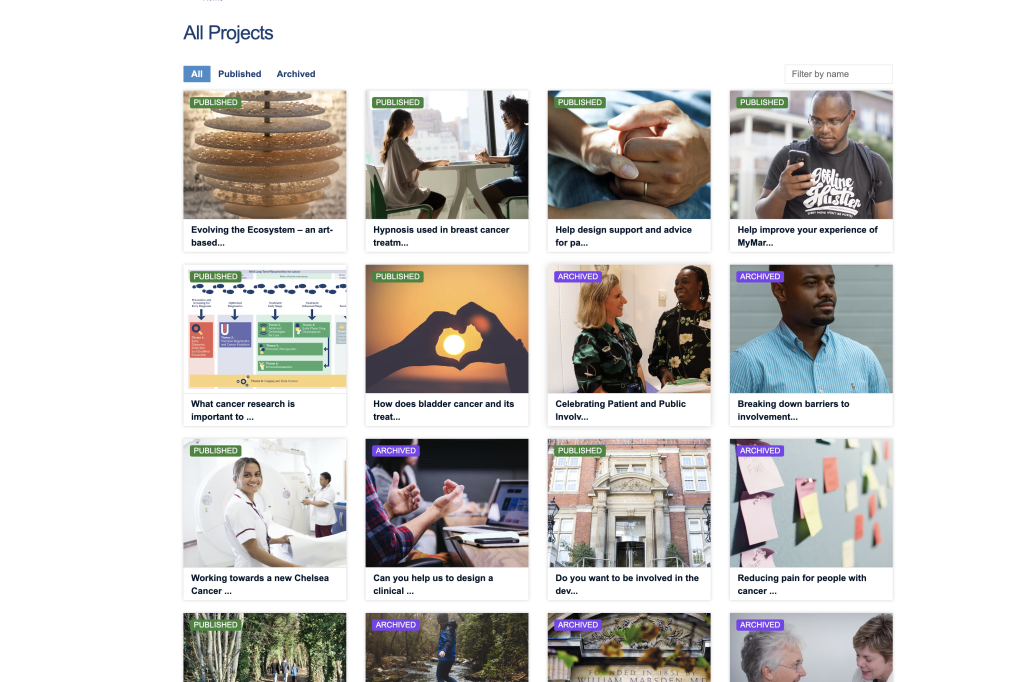
The immediate suggestions were that I have a page on their platform the Cancer Patients’ Voice and that they approach the patients on their database to see if anyone would be interested in being involved. These are both ways they habitually give patients the opportunity to join research or other activities at the hospital where patients’ input is crucial. And while my project is no way typical of the kind of thing that normally features, I was grateful that they didn’t see that as a problem – in fact they were enthusiastic about having a different sort of activity that patients might be interested to contributing to.
These images above show my page as it was published at the beginning of November. I’m also delighted that I’ve already had contacts from a number of current patients who are interested to find out more about being interviewees for the project. I am delighted as it feels llike the patients’ point of view is an critical part of understanding the ecology of cancer treatment.
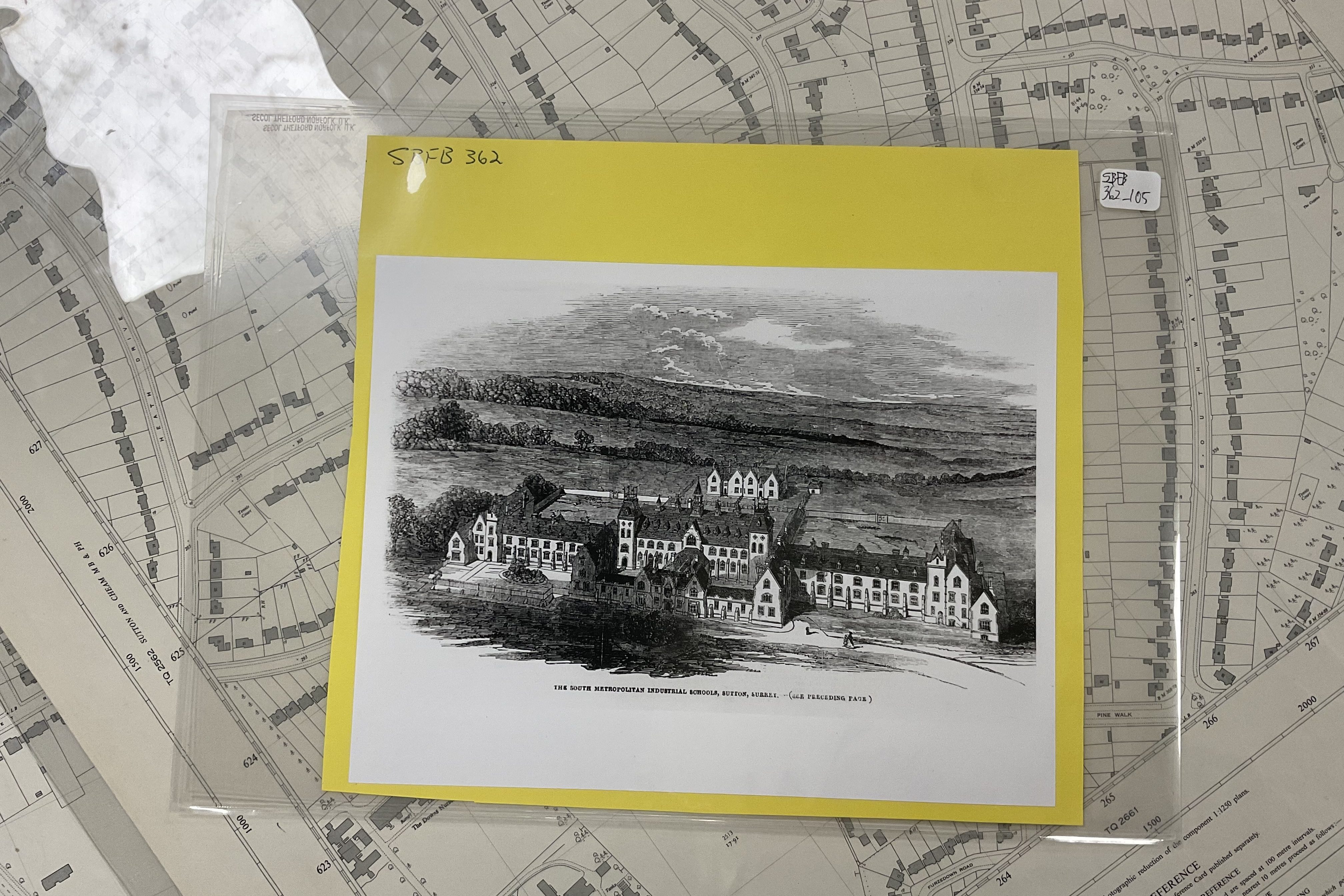
I was lucky enough recently to be able to spend a couple of hours steeped in the archive at Sutton Central Library, going through maps of the site where the London Cancer Hub is now based, and talking about the site with a member of the London Borough of Sutton team responsible for shepherding the London Cancer Hub site through the development process. Such a lot of interesting ideas emerged in one afternoon from talking about both the history and the future of the site. Once again I was overwhelmed with the amount that I learned and am full of questions about the implications for the evolution of the London Cancer Hub ecosystem as well as new ideas that may develop into artwork…
Site Plans
So, as I think i have probably already mentioned, the London Cancer Hub is made up of a number of different organisations or groups of organisation. The most significant of these that I have been thinking about are – in no particular order:
The Royal Marsden Hospital (mainly in purpose-built 1950s buildings but with a very new state-of-the-art structure)
The ICR (in brand spanking new purpose built blocks)
The Innovation Gateway (currently inhabiting a small existing mid-century block)
Maggie’s Cancer Centre (in one of their beautiful architecturally designed centres)
The element missing from that list is the major commercial site. The Innovation Gateway is the current incarnation of this, an incubator for small biotech, lifestyle and medical companies whose work fits well with the cancer focus of the Hub. But future plans are larger and more ambiutious, with a vision to house much larger companies (or parts thereof), big players in the medical and/or pharmaceutical world. There is a ‘preferred bidder’ to build this major development , with final contracts potentially being awarded in a few months time, depending on progress. The physical area for all the building to happen is currently essentially the demolition site of a number of old hospital buildings that were no longer useful and would have been complex and expensive, if not impossible, to adapt to this new purpose.
Downs / Sutton Hospital buildings scheduled for demolition
Discussion about this led quickly onto a conversation about land ownership. I had somehow assumed that there was a single site that formed ‘The London Cancer Hub’, owned by a single entity, but this is not the case. As i understand it post that conversation, the ICR owns its own plot; the NHS owns the plot on which the Royal Marsden stands, Maggie’s sits on the Royal Marsden site and the London Borough of Sutton has recently purchased the site for the commercial sector development, which as far as I can tell is referred to as The London Cancer Hub in itself also. This I think may be the root of some of the confusion that I’ve been feeling when talking to different people about the LCH – do we both mean the whole site encompassing everything, or do we mean the new commercial development? This adds to an existing confusion, for example, that I had during one conversation where the person i was talking to interpreted the London Cancer Hub as meaning the focus on the site during the pandemic for treating London-based cancer patients. I will be posting here again about some of this ambiguity, which feels quite important to the ongoing creation of a ‘London Cancer Hub’ ecology. However, ambiguity aside i found the way the sites come together to be fascinating, a real patchwork or mosaic of a site.
Site History
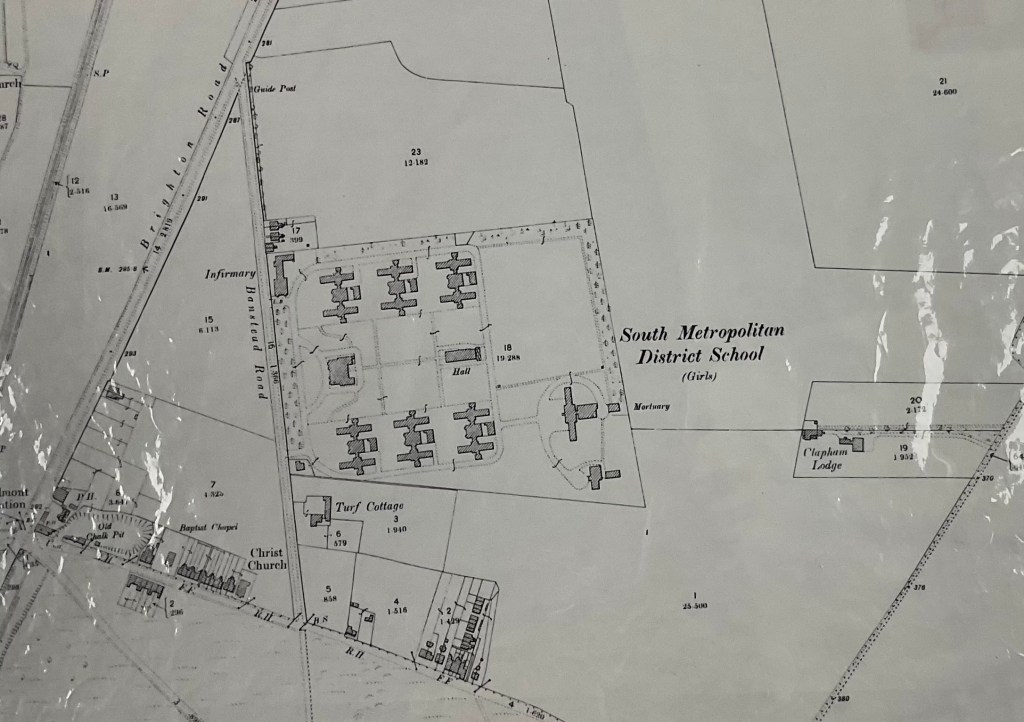
But before I get onto that, once back at the archive I had a chance to focus on the previous and historic uses of the site, which started as the South Metropolitan School for Girls in the mid 1800s.
The Site in 1896
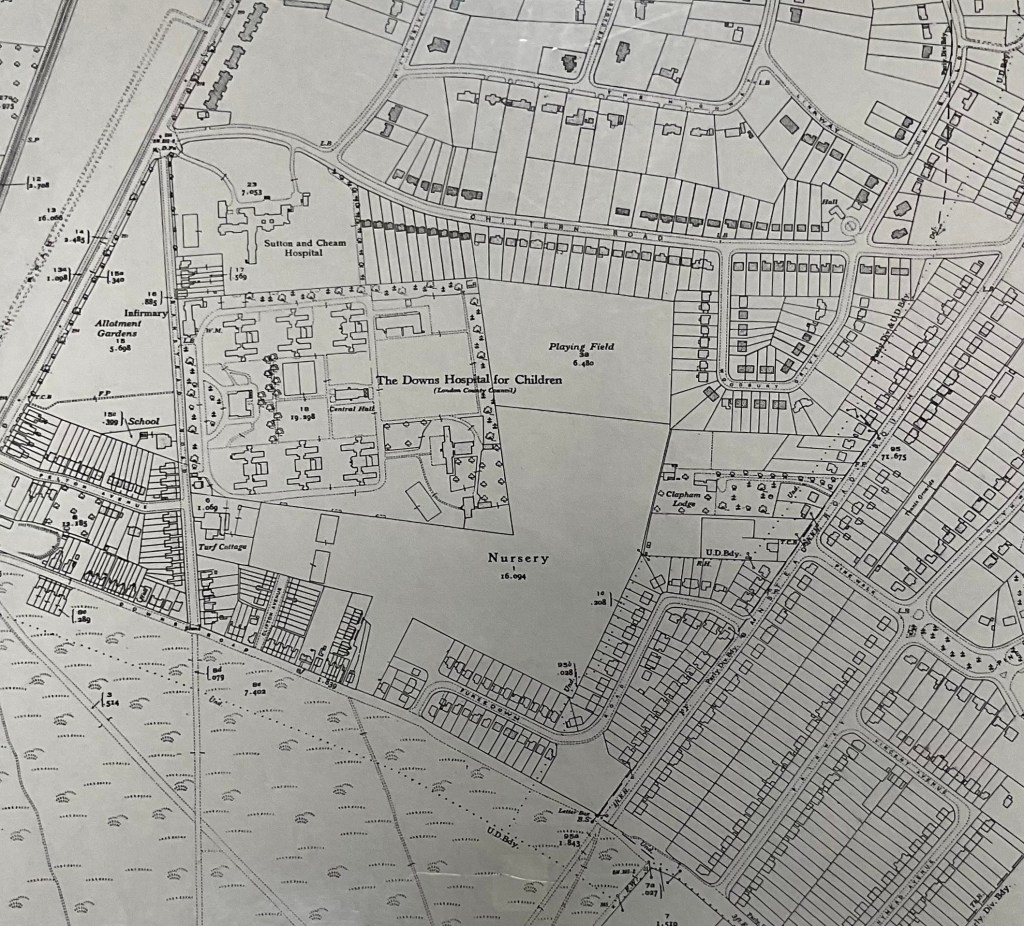
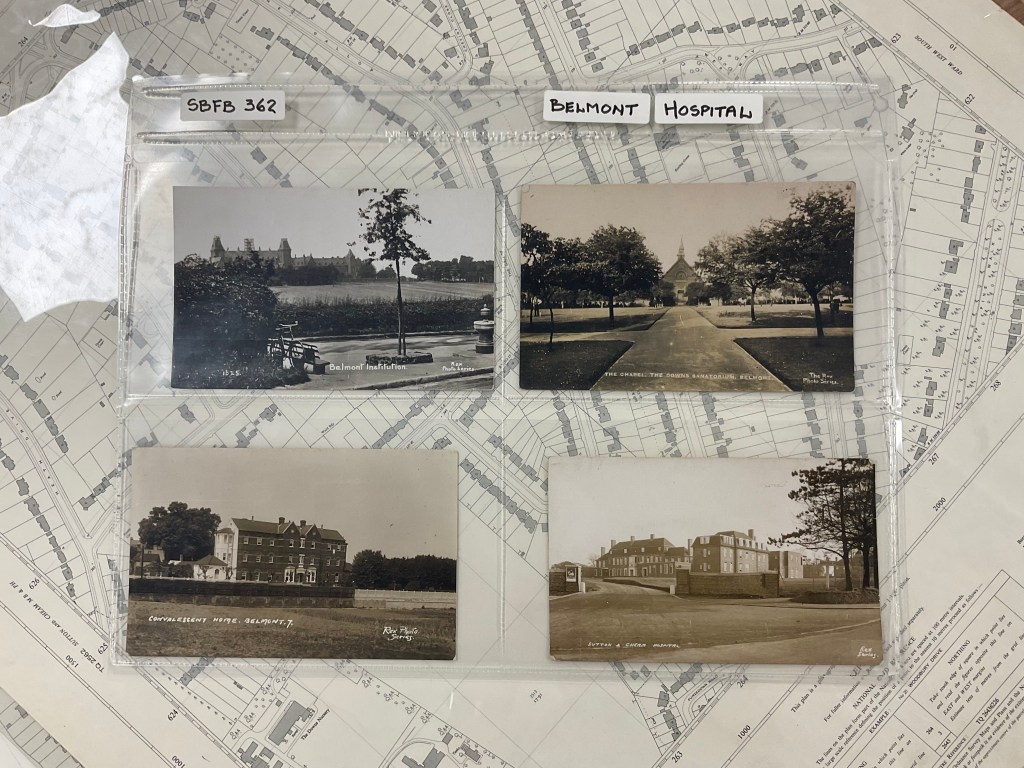
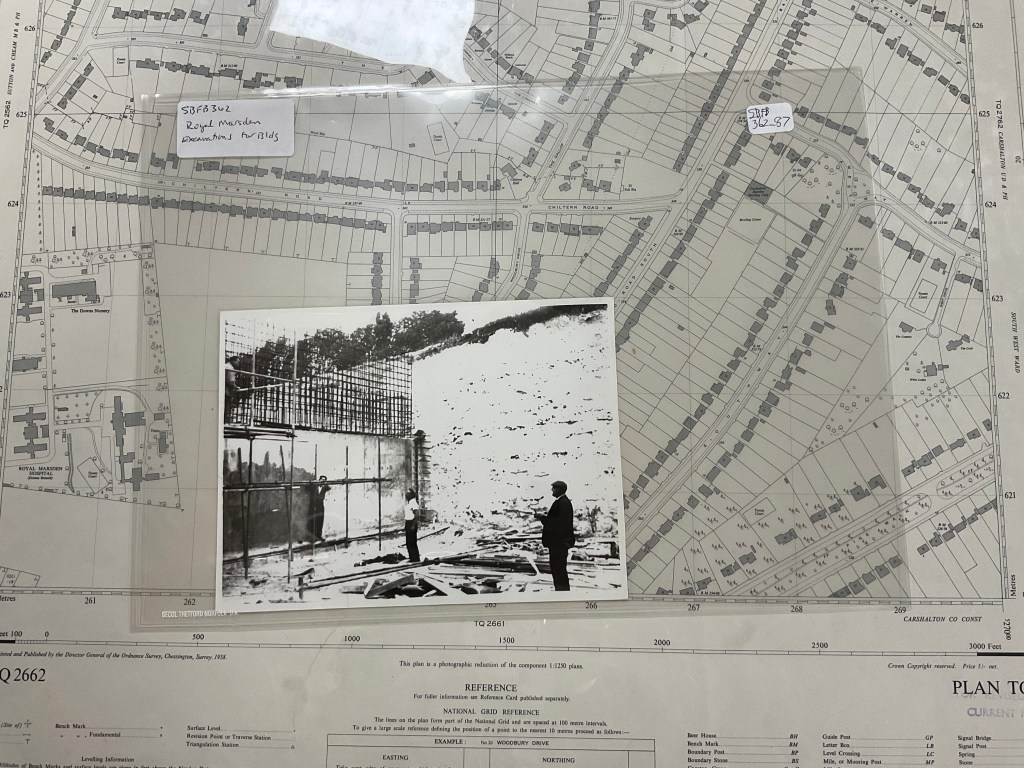
What follows is a series of images of the site over the years, thanks to the historic maps of the area, and some images of the buildings too from over the years. The building images are the ones that particularly struck me, though there were many more to choose from that might have given a more comprehensive overview of the way the buildings evolved and came together.
The Site in 1913The Site in 1935The original hospital buildings that were the Downs School, then the Belmont Hospital and then the Sutton Hosplital Digging the foundations for the Royal Marsden HospitalThe Downs Hospital in 2002
I was struck how this image is almost the same angle as the one above with the demolition barriers in place.
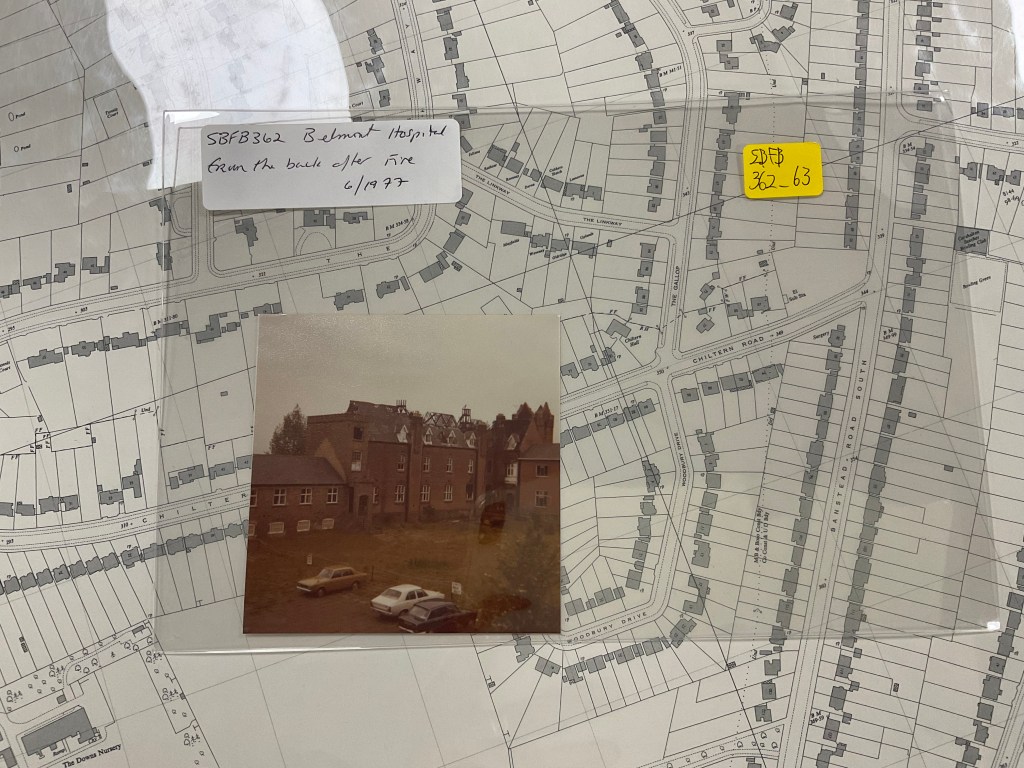
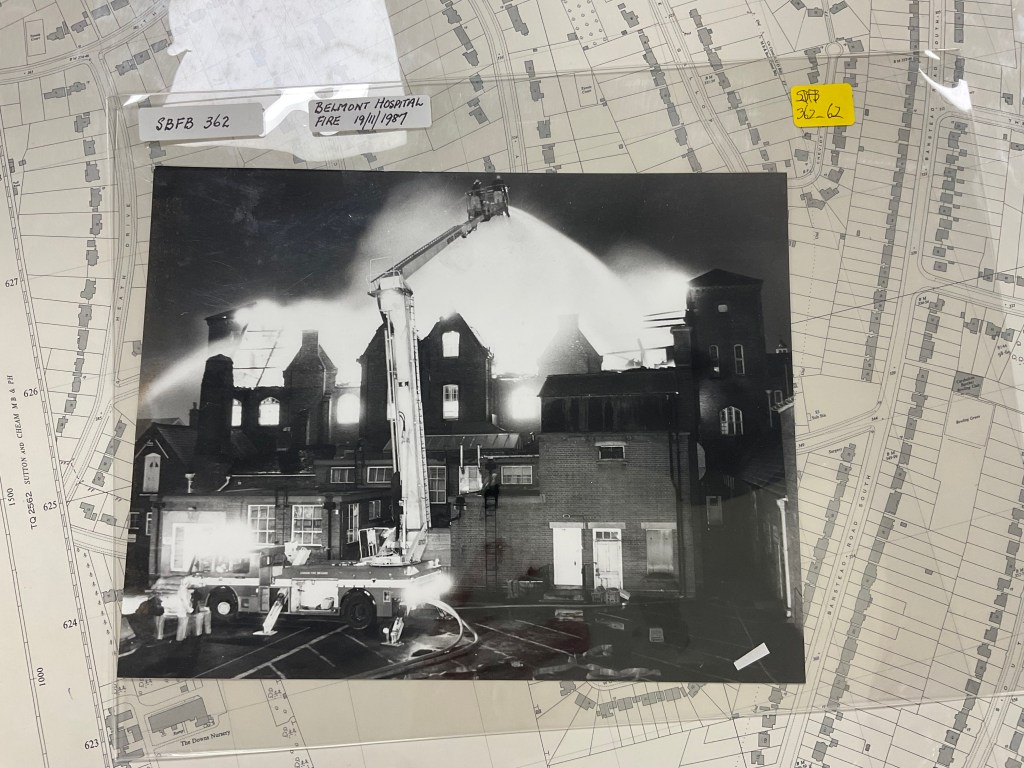
I also noticed as I pored through the images that there had been a lot of fires in the old hospital buildings.
After the Fire in 1956Ager the fire in 1977During the Fire in 1987
I’m not sure how the history of the buildings themselves or, indeed, the fires will feed into my understanding of the ecosystem, or they will feature in my artwork, but both struck me as interesting and worth recording here… The nature of the site as a mosaic of different ownerships, though, I already know is productive food for thought.
In the meantime, thanks so much to the LBS team and the archive for sharing the maps and letting me browse through the photos. Apologies that images are not great – they were my snapshots but maybe at some point I can go back and get better pictures….








 GLASS BODIES